lördag 10 april 2010

Stress and relax. The cell membrane. Brain modeling VIII a.

As we saw in previous postings the criticality, or robustness, in biology is the problem. It is too rigid. But the other way is true too, where is the non-locality and the supraconditions in the biology? Where is the mind? Where is the psyche? Where is memory and consciousness?

String-theory has exactly the same problems, but the other way round. There are only all the possibilities, but no robustness at all. Only mind without body? Can mind be part of the body? Can the problem be solved, and interactions (measurements) be done?


What happen when we do interactions/measurements of our surroundings? If we want to scale down the question we must look at the cell. How do the cell experience its surroundings? There is probably very little difference to the cell if the measurement comes from the own body or from environment. How do the cell differ of meaningful and meaningless (noise) signals? Where can we talk of stress? How do the cell handle too much stress?

If we leave the cell psychology ahead for a while, and look at the surroundings, the perceptions, and the magnetic impact. The cell psychology is as instance the qualia problem, but we have no tools yet to discuss that. We must be reductionistic in this situation.

Membranes in biology.
Membranes are bipolar lipids, with a low dielectric constant (due to fat) and a content of other molecules that can be blocked or drawn from the membrane when they are not wanted or needed. They are phagocytosed mostly. The lipid membrane is floating, loose, and an energy reservoir for phosphorylation, and at the same time a communication tool for the neighbourhood (exocrinal hormonal cell signalling, paracrine and autocrine hormonal signals), sense organs for the cell, etc.
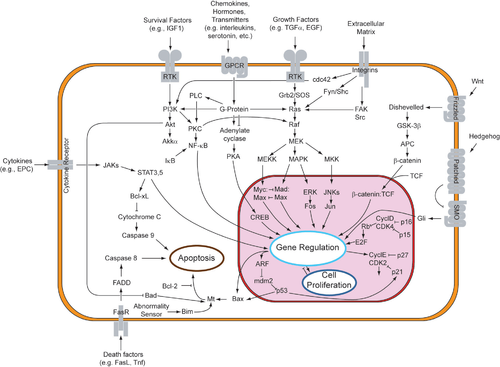
Overview of signal transduction pathways. Wikipedia. Look only at the mess.

Some signals can pass through the membrane without 'passcode', as important ones like oestrogen, insuline, thyroxine, other need a multiply of 'tests' before they are allowed to pass. A second messenger such as Ca++ or cAMP is needed. Then there are other membranes, as the nuclear envelope, that also control it's 'passports'. In principle everything that happens is part of the control output of the cell. There can be no uncontrolled things 'that just happen'.

The 'passport' can also be activated in other ways. For example, the neurotransmitter GABA can activate a cell surface receptor that is part of an ion channel. However, for many cell surface receptors, ligand-receptor interactions are not directly linked to the cell's response. The activated receptor must first interact with other proteins inside the cell, in a signal transduction mechanism or pathway.

An external signal gives conformal changes in a protein-chain interaction, the mitotic cell cycle is involved, receptors that are kinases start phosphorylation of themselves or others, and induce growth, etc. The adaptor proteines do the choise, the jump. The phosphorylated receptor binds to an adaptor protein , which couples the signal to further downstream signaling processes, for instance attach phosphate to target proteins, and alter cell cycle progression, or output. Complex multi-component signal transduction pathways provide opportunities for feedback, signal amplification, and interactions inside one cell between multiple signals and signaling pathways. What decides the choise done by the cell? Has the cell a free will? As we see many of these steps are also quantum biological. Has the quantum biology, the holographic body, any meaning for the cell?

This is a very simplified picture, where I try to point at essential features only. You can see at a sample of communication ways below. I cannot go into depth into the extremengly interesting signalling this time. You only need to know how complicated it is.


A. The cell membrane.
The cell membrane is more a loci only. A place where signals arrive. Adey, one of the pioneers and big names in this field say 1988 in 'Cell Membranes: The Electromagnetic Environment and Cancer Promotion',
...the sequence and energetics of events that couple humoral stimuli from surface receptor sites to the cell interior has identified cell membranes as a primary site of interaction with these low frequency fields. Field modulation of cell surface chemical events indicates a major amplification of initial weak triggers associated with binding of hormones, antibodies and neurotransmitters to their specific binding sites. Calcium ions play a key role in this stimulus amplification, probably through highly cooperative alterations in binding to surface glycoproteins, with spreading waves of altered calcium binding across the membrane surface. Protein particles spanning the cell membrane form pathways for signaling and energy transfer. Fields millions of times weaker than the membrane potential gradient of 10^5 V/cm modulate cell responses to surface stimulating molecules. The evidence supports nonlinear, nonequilibrium processes at critical steps in transmembrane signal coupling. Powerful cancer-promoting phorbol esters act at cell membranes to stimulate ornithine decarboxylase which is essential for cell growth and DNA synthesis. This response is enhanced by weak microwave fields, also acting at cell membranes
.
Adey says that cell membranes, in coupling humoral stimuli (hormones, neurotransmitters and antibodies) from surface receptor sites to the cell interior, functions as a primary site of interaction with weak oscillating EM fields in the pericellular fluid. This would mean that the primary signal comes not from the cell alone, but from the cell environment. And the signal is forcefully amplified in the passage through the membrane. This we know is true, but not in every case. The important GCPR-receptors stand out here, making up for about half of all receptors. They are most often the targets for the drugs. EM fields in fluid surrounding cells modulate inward and outward signal streams through cell membranes. Is this the real impact? He writes:
Careful evaluation of these field actions has revealed subtle effects that betoken mechanisms of interaction based on long range interactions and nonequilibrium processes. Temperature increments are not the primary substrates of the observed biological sensitivities.

This was tested for lymphoid cells (leukemia) in 1995. Electromagnetic waves (1G, 60 Hz -this is quite high stimulus level) stimulates the protein tyrosine kinases, so that it results in tyrosine phosphorylation of multiple electrophoretically distinct substrates, and leads to downstream activation of protein kinase C (PKC). A wave of 'destruction' into the cell. But this destruction is selective, some kinases are stimulated, and a delicate growth regulatory balance might be altered.

In fact there are many studies revelaing a link between cancer and EM-fields. Humanmade fields are substantially above the naturally occurring ambient electric and magnetic fields of ~10^-4 Vm^-1 and ~10^-13 T, respectively. Several epidemiological studies have concluded that ELF-EMFs may be linked to an increased risk of cancer, particularly childhood leukemia. How might EMFs induce cancer?

Magnetic fields can also change the opioid levels, by modulating the gene expression.
Ventura et al. writes:
Magnetic fields have been shown to affect cell proliferation and growth factor expression in cultured cells. Although the activation of endorphin systems is a recurring motif among the biological events elicited by magnetic fields, compelling evidence indicating that magnetic fields may modulate opioid gene expression is still lacking. We therefore investigated whether extremely low frequency (ELF) pulsed magnetic fields (PMF) may affect opioid peptide gene expression and the signaling pathways controlling opioid peptide gene transcription in the adult ventricular myocyte, a cell type behaving both as a target and as a source for opioid peptides.
Conclusions: The present findings demonstrate that an opioid gene is activated by myocyte exposure to PMF and that the cell nucleus and nuclear embedded PKC are a crucial target for the PMF action. Due to the wide ranging importance of opioid peptides in myocardial cell homeostasis, the current data may suggest consideration for potential biological effects of PMF in the cardiovascular system.
Vetura, cont.
Magnetic fields may elicit multiple effects in biological systems, including behavioural changes in intact organisms. Effects of MF on opioid-related events may have important implications in cellular homeostasis. Among the regulatory systems that appear to be targeted are endogenous opioid peptides. MF can produce analgesic effects through an opioid receptor-mediated mechanism and are able to affect the spontaneous electrical brain activity by interfering with the action of both exogenous and endogenous opioids. In mice, MF have been found to enhance the duration of pharmacologically-induced anaesthesia by releasing endogenous opioids and/or enhancing the activity of opioid signaling pathways. The capability of MF of controlling the central cholinergic system also appears to depend on the activation of an opioidergic pathway. Opioid receptor antagonism also attenuated MF-induced antiparkinsonian effects in man. Opioid peptides may act as growth modulators and may control both cell differentiation and architecture in a wide variety of tissues. The myocardial cell responds to opioid receptor stimulation with deep changes in cytosolic Ca2+/pH homeostasis and contractility. Dynorphin B released Ca2+ from an intracellular store acted in an autocrine fashion to stimulate the transcription of its coding gene (for dynorphin B), involving an impairment of cell growth and differentiation. A delicate growth regulatory balance may be altered following nuclear PKC activation by PMF. PMF-induced prodynorphin gene transcription resulted in the increase of both intracellular and secreted dynorphin B. Dynorphin B is known to bind selectively opioid receptors and the stimulation of these receptors in cardiac myocytes has been shown to promote phosphoinositide turnover, depletion of Ca2+ in the sarcoplasmic reticulum and leading to a marked decrease in the amplitude of the cytosolic Ca2+ transient oscillations and in that of the associated contraction of the heart. Ventura et al ask: Why would hearth cells have a system capable of reacting to PMF? In isolated nuclei an opioid gene can be independently and fully activated by PMF, as in the intact cell. The property of conveying nuclear signaling to the modulation of gene transcription may disclose new perspectives in the molecular dissection of the biological effects.

Magnetic fields may
- alter human cardiac rhythm (Ventura et al.)
- enhance the occurrence of arrhythmia-related heart problems (Ventura et al.)
- induce stress responses that protect the embryonic myocardium from anoxia damage (chick)
- influence the spontaneous electrical brain activity (rat) (Vorobyov et al.1998.) consistent with the findings of other groups demonstrating that weak magnetic fields may drastically modify the effects of both exogenous and endogenous opioids on different basic functions in vertebrates and invertebrates.

Lithium- and dopamine effects.
Modification of a brain opioid system may contribute to the clinical response to lithium. Li increase the phosphorylation, but not in the presence of Ca2+ or Ca2+ and calmodulin. Chronic lithium treatment affects some signal transduction mechanisms such as cAMP, cGMP, inositol 1,4,5 P3, Gi protein, protein kinase C and can also modify gene expression in rat brain. Li affects the adrenoceptors and their half lives (=turnover rate). Administration of Li is associated with a reduction in retinal light sensitivity, but chronic lithium use is not associated with differences in retinal light sensitivity, and no retinal toxicity is feared. Li diminish neostriatal dopaminergic activity, but the underlying mechanisms do not appear to involve modifications in either the D1 or the D2 receptor primary ligand recognition sites. The hypothesis of an increased dopamine synthesis is not supported and Li modified the affinity of DA transporters for the radioligand, possibly a consequence of conformational changes induced by the disruption of the nerve terminal membrane environment. Lithium blocks isolation-induced hypersensitivity, especially of the β-adrenergic system. Isolation reduce motor activity, seen in rats. Lithium has an inhibitory effect on neuroleptic receptors ([3H]spiroperidol binding sites) in the limbic-forebrain and on serotonin receptors ([3H]serotonin binding sites) in the hippocampus. Serotonin directs the attention amongst others. The effect of lithium ion on the electrically stimulated 5-[3H]hydroxytryptamine (5-HT) release from the rat hippocampal decreased when exposed to 5-HT, but Li did not affect release alone but inhibited together with serotonin. Li may inhibit the regulation of 5-HT release via presynaptic 5-HT autoreceptors in rat hippocampus.
The response on penile erection induced by apomorphine, a mixed Dl/D2 dopamine receptor agonist, (0.05-0.5 mg/kg), was decreased in animals pretreated with chronic lithium, and inhibitory effect of sulpiride increased too. No bliss with Li.

Serotonergic (5-HT) dysfunction has been hypothesized in mania, but the results are inconsistent. The platelet 5-HT2 receptor is neither a state marker nor a trait marker in mania, and maybe the serotonin hypothesis is wrong. There are though a clear up- or down-regulation of platelet serotonin receptor responsiveness in bipolar and unipolar depression.

The effect on second messengers is interesting too. Lithium reduced the inhibitory ability of carbachol, and reduced the degree of stimulation of formation of inositol phosphate, induced by noradrenaline. Chronic effects of administration of lithium may be related to actions at the G protein level and that different modes of coupling of receptors to G proteins may be responsible for the variety of effects observed.

A selective D1 dopamine receptor antagonist, blocked an increase in cAMP formation of all of the dopamine agonists investigated. Are there a relationship between the D1 receptor-stimulated increase in cAMP formation and the induction of dyskinesia in Parkinsonian humans? Robust catalepsy follow from D1 receptor blockade (rat), while dopamine agonists (as apomorphine) effects on bradycardia (induced by stim vagus nerve) decreased significantly the vagal nerve -induced (but blocked by sulpiride) but not the acetylcholine-induced bradycardia, and suggest the presence of presynaptic and/or ganglionic dopamine DA2 receptors in the parasympathetic innervation of the rat heart, stimulation of which inhibits the release of acetylcholine. As a parenthesis I must say Li is mostly used to prevent mania. Stork & Renshaw, 2005, propose a hypothesis of mitochondrial dysfunction in bipolar disorder that involves impaired oxidative phosphorylation, a resultant shift toward glycolytic energy production, a decrease in total energy production and/or substrate availability, and altered phospholipid metabolism.

Dopaminergic and opioidergic systems interact in the striatum in the brain to modulate locomotor and motivated behaviors. Dopamine modulate opioid receptor-mediated signal transduction. Repeated activation of D1 receptors attenuates the functional coupling of delta opioid receptors with adenylyl cyclase due to decreased coupling between delta receptors and G proteins.

Li acts through cyclotrone resonanse frequencies, as Ca, and Fe do? It's secrets cannot be revealed on cellular level?

Age and cAMP-production.
Blood vessels from aged animals and humans have impaired relaxation and cAMP production to β-adrenergic stimulation, but direct activators of adenylyl cyclase are not affected. Would the effects on cAMP production occur in membrane? Aortic media membrane was studied in rats. Basal AC activity increased significantly with age, but no age-related decrease in responsiveness for G protein activators, or receptor agonists β-adrenergic and PGE-1 (prostaglandin). The membrane system to assess age-related changes in β-adrenergic responsiveness seem not be the case. Cocaine reduce cAMP production, as age do. A functional change in a critical signal transduction pathway and effects the development of the brain.

Overall membrane charachters.
So, it seem it is not the membrane that is magnetically active, but the receptors, and they may be activated through an magnetic attraction of the second messengers cAMP, Ca++, GTP etc. These second messengers then amplify the signal.

But the membrane give very clear response in magnetic induction fields, seen in fMRI. The cell membrane and especially its receptors, acts as a capture for magnetic waves, just as the genes are captures, seen in the promoter genes. The magnetic field (weak permanent homogenous hirizontal magnetic field (PMF) 400 A/m) affects the lipid constitution too. In radish seedlings Novitskaya et al. found that PMF increased the ratio of phospholipids to sterols by 30–100%, and suppressed the formation of polar lipids in light (by 18%), whereas in darkness, it stimulated it approximately by 80%, very temperature dependant. PMF exerted the strongest effect on the content of erucic acid. PMF behaved as a correction factor affecting lipid metabolism on the background of light and temperature action. Membrane composition also varies between vertebrates and the degree of polyunsaturation of membrane phospholipids is correlated with cellular metabolic activity, so that more phospholipids give a faster metabolism. Membranes can act as pacemakers for overall metabolic activity. Such membrane polyunsaturation increases the molecular activity of many membrane-bound proteins and consequently some specific membrane leak–pump cycles and cellular metabolic activity. A greater transfer of energy during intermolecular collisions of membrane proteins with the unsaturated two carbon units (C=C) of polyunsaturates compared to the single carbon units of saturated acyl chains, as well as the more even distribution of such units throughout the depth of the bilayer when membranes contain polyunsaturated acyl chains compared to monounsaturated ones. The proposed pacemaker role of differences in membrane bilayer composition have importance to the brain (and sensory cells), evolution of mammalian endothermic metabolism, etc.

When a cell is exposed to a time-varying magnetic field, this leads to an induced voltage on the cytoplasmic membrane, as well as on the membranes of the internal organelles, such as mitochondria. These potential changes in the organelles could have a significant impact on their functionality. The amount of polarization in the organelle was less than its counterpart in the cytoplasmic membrane. This was largely due to the presence of the cell membrane, which "shielded" the internal organelle from excessive polarization by the field. Organelle polarization was largely dependent on the frequency of the magnetic field.


Regional polarization of the cytoplasmic membrane and the organelle membrane by the time-varying magnetic field. The plot demonstrated an instant polarization pattern on both membranes. The color map represented the amount of polarization (in mV) calculated with the standard values listed in table 1. A. Field frequency was 10 KHz. B. Field frequency was 100 KHz. Ye et al. 2010.

The effect is also seen in a pattern generation of the molecules in the cell membrane. Distinct 'fields' are clearly seen. This is partly a result of chemical attractions, but also electric and magnetic. The danish solitonic nerve pulse model clearly show such patterns.


Electric field vector plot and potential distribution near the plasma membrane with mobile surface charges in an alternating electric field. The uniform electric field in the cell is greater at (a) 106 Hz than at (b) 102 Hz. The excitation field is 1.0 V/cm. Vajrala et al. 2008. Observe that this is an electric field.

Elastic fibres have important cell adhesion functions. Electron microscopy and biochemical studies have highlighted strong interaction with their subendothelial elastic fibre-containing matrix, and with juxtaposed elastic fibre lamellae at cell surface dense plaques. These interactions are mediated mainly through heterodimeric transmembrane receptors.

Many diseases depends on the microtubuli - attatchment to the cell membrane. Myotrophies as Duchennes and Beckers dystrofies are one result. Without a proper cytosceleton the cell cannot work.


B. How might EMFs induce cancer?
Lacy-Hulberta et al. writes:
Free radicals are generated as intermediates in metabolism and may attack lipids, proteins, and DNA. Thus, any elevation in free radical production could increase the rate of chemical damage to DNA as occurs, for example, as a consequence of sustained activation of the immune system in response to chronic infection. Magnetic fields of more than 1 mT can have measurable effects on the kinetics and yield of chemical reactions that use geminate radical pairs through their effect on the spin precession rates of unpaired electrons and consequent effects on the lifetime of radicals. The magnetic field can increase or decrease precession rates between singlet and triplet spin-correlated states. Hence, a geminate radical pair born in the singlet spin state may rapidly recombine; after precession to the triplet spin state, recombination is prohibited by the Pauli exclusion principle, resulting in a longer radical lifetime. The consequence of this may be, for example, increased enzyme product or release of radicals from the enzyme.


Electromagnetic field effects on free radical processes. A) A reaction between two species can generate a pair of radicals in the triplet state with parallel electron spin. If one of the electrons converts to a different state, changing its spin, the radical pair can react to form product. B) This change involves transfer of the electron between the three triplet states: T0, T-1, and T+1. These states are normally degenerate, but in a magnetic field the energies separate. When this separation is less than the hyperfine reaction for the system, the radicals created in the triplet states can be transformed into singlets and react. When the separation is greater than the hyperfine reaction, radicals created in T-1 and T+1 triplet states cannot interconvert and hence reaction cannot take place. However, an alternating magnetic field of frequency {upsilon} can excite electron transitions between levels, allowing transition to the singlet states even in high magnetic fields.

Alternating magnetic fields superimposed on static magnetic fields can further affect reactions by providing quanta of energy equal to the gap between singlet and triplet states, allowing transition of radicals and hence increasing reaction probability. The effect requires both static magnetic fields and fields fluctuating at a resonance frequency. These examples (ROS, neutrophiles) represent clear, reproducible effects of magnetic fields on biochemical systems with a firm theoretical basis. Effects are reported from 0.1 mT fields at 60 Hz. Nitric oxide production is also interesting, as other immune reactions.

Lacy-Hulberta:
A free radical basis for magnetic field effects would have some important implications for investigations and epidemiological studies. The processes affected occur very rapidly, and so at the level of simple effects are independent of frequency; in many cases, the geomagnetic field exposure would far outweigh the alternating field. However, as described above, more complex effects can occur in vitro with specific combinations of static and alternating magnetic fields, and these combinations vary with the free radical species involved.


This also correlates with the radical-pair theory of Ritz mentioned in earlier posting. Also with the laser-effects found by Tiina Karu. Seedling growth magnetically sensitive as a result of photoinduced radical-pair reactions in cryptochrome photoreceptors—tested by measuring several cryptochrome-dependent responses, all of which proved to be enhanced in a magnetic field of intensity 500 μT, show a way forward.

C. The Extracellular Matrix (ECM).
Disturbances and dysfunctions are most evident effects of longterm illness, and medicines seldom can change this. Is the reason somewhere else? In the synchronisation/control-levels, but not at cell-level? To believe something else only means misuse of medicine? We need to look at the networks, to step up a level in the molecular hierarchies. Maybe the reason to the induced control-signals are found there?

We have seen that many of the signals indeed arrive from outside the cell, even gene regulation signals. When we look at the SRP-molecule in the promoter-gene we find all those loops that will change the magnetic field very strongly, make superpositions as Lacy-Hulberta et al. suggests.

In fact, Nature herself use networks, as seen in nerves, blood circulation, gap junction systems, nanotubes, hormonal systems, meridians etc. Maybe there are an oxygen network too, as Mae Wan Ho said? Oxygen makes more energy available and at greater efficiency; at the same time, it increases the complexity of metabolic networks. A network that take part very much in the relaxation in form of negentropic bindings. A fast relaxation is important for the functions in the organisms. They are as important as the very minute signal is. In fact,it is exactly the relaxation that make up the robustness and criticality in matter. It is the probabilities that changes in different magnetic fields, The relaxation leads to polarization. Adhesion and adsorption makes it go faster and time is very important too.

Paluch et al. writes 2006:
The shape of animal cells is, to a large extent, determined by the cortical actin network that underlies the cell membrane. Because of the presence of myosin motors, the actin cortex is under tension, and local relaxation of this tension can result in cortical flows that lead to deformation and polarization of the cell. Cortex relaxation is often regulated by polarizing signals, but the cortex can also rupture and relax spontaneously. A similar tension-induced polarization is observed in actin gels growing around beads, and we propose that a common mechanism governs actin gel rupture in both systems.


We shall look at yet a network, the extracellular matrix, that do supramolecular organizations, and is non-local and very fast. But that will be in a new posting, 'Stress and relax. The Extracellular Matrix. Brain modelling VIII b', coming soon.

I will finish with some words from Matti Pitkänen.
In this framework the energy feed to the system means that the (quantum) superposition changes in such a manner that the average energy of the positive energy state increases. This excites new degrees of freedom and makes the system more complex. The dissipation caused by quantum jumps reducing entanglement entropy tends to reduce the average energy and this tendency is compensated by the energy feed selecting also the most stable self-organization patterns as a flow equilibrium.


The hologrammic organization is the ultimate, most stable organization. But in a holistic model ought the gravity also be included. Maybe we will soon know what gravity really is?


References:
W.R.Adey 1988: Cell Membranes: The Electromagnetic Environment and Cancer Promotion. Neurochemical Research, Vol. 13, No. 7, 1988, pp. 671-677. http://www.springerlink.com/content/h507p8wq85141871/fulltext.pdf?page=1

W. Ross Adey 1993: Biological Effects of Electromagnetic Fields. Journal of Cellular Biochemistry 51:410-416 (1993). http://www.energycelltherapy.co.uk/pdfs/biological.pdf

Sue-Re Harris, Kevin B. Henbest, Kiminori Maeda, John R. Pannell, Christiane R. Timmel, P.J. Hore and Haruko Okamoto, 2009: Effect of magnetic fields on cryptochrome-dependent responses in Arabidopsis thaliana. J. R. Soc. Interface 6 December 2009 vol. 6 no. 41 1193-1205.
http://rsif.royalsocietypublishing.org/content/6/41/1193.full

Adam Lacy-Hulberta, James C. Metcalfea, and Robin Hesketh, 1998: Biological responses to electromagnetic fields. The FASEB Journal. 1998;12:395-420. http://www.fasebj.org/cgi/content/full/12/6/395

E. Paluch, J. van der Gucht, and C. Sykes (2006): Cracking up: symmetry breaking in cellular systems. J. Cell Biol. 175, 687-692 http://jcb.rupress.org/content/175/5/687.abstract

Fatih M. Uckun, Tomohiro Kurosaki, Jizhong Jin, Xiao Jun, Andre Morgan, Minoru Takata, Joseph Bolen and Richard Luben, 1995: Exposure of B-lineage Lymphoid Cells to Low Energy Electromagnetic Fields Stimulates Lyn Kinase. November 17, 1995 The Journal of Biological Chemistry, 270, 27666-27670. doi: 10.1074/jbc.270.46.27666

Vijayanand Vajrala, James R. Claycomb, Hugo Sanabria, and John H. Miller, Jr., 2008: Effects of Oscillatory Electric Fields on Internal Membranes: An Analytical Model. Biophys J. 2008 March 15; 94(6): 2043–2052. doi: 10.1529/biophysj.107.114611. PMCID: PMC2257880 http://www.ncbi.nlm.nih.gov/pmc/articles/PMC2257880/?tool=pubmed

Vasily Vasilievitch Vorobyov, Evgeni Alekseevitch Sosunov, Nikolai Ilitch Kukushkin and Valeri Vasilievitch Lednev, 1998: Weak combined magnetic field affects basic and morphine-induced rat's EEG. Brain Research Volume 781, Issues 1-2, 19 January 1998, Pages 182-187. doi:10.1016/S0006-8993(97)01228-6

Carlo Venturaa, Margherita Maiolia, Gianfranco Pintusa, Giovanni Gottardic and Ferdinando Bersani, 2000: Elf-pulsed magnetic fields modulate opioid peptide gene expression in myocardial cells. Cardiovasc Res (2000) 45 (4): 1054-1064. doi: 10.1016/S0008-6363(99)00408-3

Hui Ye, Marija Cotic, Eunji E Kang, Michael G Fehlings, and Peter L Carlen, 2010: Transmembrane potential induced on the internal organelle by a time-varying magnetic field: a model study. J Neuroeng Rehabil. 2010; 7: 12. doi: 10.1186/1743-0003-7-12. PMCID:PMC2836366 http://www.ncbi.nlm.nih.gov/pmc/articles/PMC2836366/

tisdag 6 april 2010

Sensitivity. Brain modelling VII.


"But one serious question would arise at this point. That is, how could one guarantee the robustness of such seemingly classical phenomena including our brain activities." - Matsuno Koichiro. "It seems that consciousness operates very well in the classical realm." In: A Quantum Leap in Biology. The quantum criticality is the big problem. Is the Schrödinger cat dead or alive?


In previous posting we saw that it was coordination and control that governed living matter. Coordination is negentropy that diminish the degrees of freedom, control is entropy, a growing energy inflow and chaos. Phase transitions and quantum tunnellings, that is motor reactions, are maybe the outcome of control. It is quantum tunnelling that diminish the degrees of freedom most. Receptors are very much about quantum tunnelling. According to the earlier post this also determine the sensitivity of living matter, through subCDs ('causal diamonds'), branchings, fractality and topology; that is by maximazing the negentropy.

Neuronal synchronization, coordination.
Synchronization is spatial and temporal, non-dissipative and negentropic. It is one part of the sensitivity. Neurons are indeed capable of synchronizing to increase the sensitivity. Neuronal networks appear to respond to fields with more sensitivity than single neurons. A collective population effect seen in detector numbers and/or their couplings. (I) Branching gives a higher sensitivity.

The other part of sensitivity is control. Modulation by small fields has advantages in control devices that use electric fields to modulate neuronal networks. Photons can be used as well, as seen in Popp's works. The control can both stimulate and inhibite and operate at the smallest possible field strength to minimize the potential for unwanted functional effects or tissue damage from long-term chronic stimulation. An extremely small signal is used, related to the sensitivity.

Peripheral nerves are situated in a highly non-homogeneous environment, including muscles, bones, blood vessels, etc. what makes the control much more difficult. The control signal must be well directed and meaningful (not give dissonances). This answers the question 'When is this interaction harmful?' Information about the perceptive environmental or endogen field = disturbances of the harmonic synchronity. So we have a synchronity that is disturbed (stressed). Is the outcome harmony, then we talk of regulation, but if the outcome is disharmony it can still be regulated by inducing more stress (giving more energy), until next harmonious level is reached. This we call allostasy. Disease can also be seen as allostasy, if it make the individ change his perception fields (energy intake) or balance his degrees of freedom seen in organization (change his lifestyle often).

In the case of magnetoreception we have to use amplitude windows (that is the perception fields for our senses), that is, to shield against too high environmental or endogen magnetic influence, so we can keep the sensitivity. But to shield too much is not good either. Living systems benefit from magnetic fields, and give more motor output. Living systems are open systems that interact with the environment. The sensitivity is resonating too? Too much or too little control give an stress-effect. It is the control functions that have the most severe impact from ELF-fields, as Pitkänen suggests? Homeostasis is normal biocontrol with negative control loops, striving to harmony; allostasis is a control with exaggerated loops that enlarge the disturbance, until it reach harmonious levels?


Extremely low frequency (ELF) magnetic fields.
Magnetic fields can be percieved but not electric fields (Marino & Becker). Magnetic fields give mostly an effect on the motor output of the system, where short-term memory, cognition, psychomotor functions and biochemical reactions all are included. Magnetic fields have links to photoreception in the eye, and produce lightphenomena.

One of the key questions related to interactions of low-frequency magnetic fields with biological systems is which parameters of the exposure field are responsible for observed effects. When a cell is exposed to a time-varying magnetic field, this leads to an induced voltage on the cytoplasmic membrane, as well as on the membranes of the internal organelles, such as mitochondria. It do not have to be the field that change,the same result comes from a living object moving in graded fields. And magnetic fields have often a steep gradient. Spatial patterns of induced electric fields and currents in the tissues are important, seen in A 3-D pattern, or 4-D if the time aspect are included (the locomotion or the wave density). Consciousness is perhaps a derivate of time as sampled moments (Popp)or stories.

Baureus et al could quantitatively confirm the quantum mechanical theoretical model by Blanchard,which assume that biologically active ions can be bound to a channel protein and influence the opening state of the channel. Suitable combinations of static and time varying magnetic fields directly interact with the Ca(2+) channel protein in the cell membrane.
A random model indicates that for higher cell densities the pattern of the induced current flow depends mostly on the actual cell placement. Gap junctions, not surprisingly, are shown to increase the current density (they form networks), but only if their resistance is sufficiently low. The highest current density occurs in the gaps. Lowest resistence is in the acupunctures (and meridians, with gap-junctions).

Ritz, 2000, has made a radical-pair theory for MF-ELF. Behavioral and theoretical studies suggest a link between photoreception and magnetoreception in some animals, as seen in migrating birds etc. They claim the possibility that magnetoreception involves radical-pair processes that are governed by anisotropic hyperfine coupling between (unpaired) electron and nuclear spins. Theoretically fields of geomagnetic field strength and weaker can produce significantly different reaction yields for different alignments of the radical pairs with the magnetic field. As a model for a magnetic sensory organ we propose a system of radical pairs being
1) orientationally ordered in a molecular substrate and
2) exhibiting changes in the reaction yields that affect the visual transduction pathway. 3-D visual modulation patterns can arise from the influence of the geomagnetic field on radical-pair systems. The variations of these patterns with orientation and field strength can furnish the magnetic compass ability of birds with the same characteristics as observed in behavioral experiments. He proposes that the recently discovered photoreceptor cryptochrome is part of the magnetoreception system.


The model seems to hold. It have been prooved a lot since 2000.

To describe the interactions of weak electromagnetic fields on channel proteins in the cell membrane, Malka, 2009, evaluated three models. The Ion Parametric Resonance model predicts a biological response at well-defined resonance frequencies for magnetic fields exceeding about 10 micro-Tesla. The oscillating magnetic field is assumed to act on proteins together with the earth's static magnetic field. This model predicts amplitude windows. We explain how a purely magnetic interaction, where in a two-stage ion magnetic resonance model, the conformation of a protein is changed under the influence of ions attached to its surface, which in turn, changes the function of the protein, can overcome the inherent signal-to-noise problem caused by electric thermal noise.
The hydrogen nuclear polarization model predicts a biological response for oscillating magnetic field strengths above 0.1 micro-Tesla. The presence of a static magnetic field is required, and biological effects can be expected for frequencies below a few hundred hertz.
The forced vibration model cannot be applied for amplitude modulated microwaves.

Saunders et al. The integrative properties of the synapses and neural networks of the CNS render cognitive function sensitive to the effects of physiologically weak electric fields, below the threshold for peripheral nerve stimulation (cognitions are subconscious). However, the only direct evidence of these weak field interactions within the CNS is the induction of magnetic phosphenes in humans-the perception of faint flickering light in the periphery of the visual field, by magnetic field exposure. Other tissues are potentially sensitive to induced electric fields through effects on voltage-gated ion channels, but the sensitivity of these ion channels is likely to be lower than those of nerve and muscle cells specialized for rapid electrical signaling. In addition, such tissues lack the integrative properties of synapses and neuronal networks that render the CNS potentially more vulnerable. See Marino & Becker for more details.


AC/DC electric fields.
AC sinusoidal electric fields have smaller effects on transmembrane potentials: sensitivity drops as an exponential decay function of frequency. At 50 and 60 Hz it is approximately 0.4 that for DC fields. This gives a smaller window for changing fields (maybe by creating standing waves). In AC fields, particles experience polarizing effects that induce dipoles that orient elongated specimens either parallel or perpendicular to the field lines, seen in for instance photoreceptor cells. The internal structure of the rods is complex, hundreds of membrane sacs (disks) being packed in a very ordered manner (the disks stack). The primary reactions of visual transduction occur within the disk membrane. (II)Ordered, negentropic structures are more sensitive to ELF-fields.

The cells are orienting, deforming, moving, or rotating. These effects originate in the interfacial polarization produced by AC field at the structural interfaces within the cell. Interaction of the induced cellular dipole with the external field results in translation or rotation of cells, according to their dielectric properties. (III) Interfaces, or extracellular spaces are more sensitive than intercellular structures.

Whether weak environmental ELF fields affect neuronal firing will be a function of the reduction in ambient field by the anatomic layers surrounding the brain and the neuronal modulation threshold. Anatomic layers are perineural sheat, myelin, fat, membranes etc.

How is the shielding done?
Oriented low amplitude effects, as in lipid layers, are distinct from the depolarization block seen with unoriented fields of higher amplitude and frequency.

1. Depolarisation effects.
- transmembrane potentials, lipids have a low dielectric constant. In the case of extremely low frequency electric fields (ELF, 1–300 Hz) modulation of membrane potential is the most likely. The linear dielectric response of cells in suspension directly correlates with the membrane potential. The extreme shielding is the myelin-sheat around the axons. The condition of the cell membrane is also very important; cholesterol, proteines, enzymes etc. Mitochondrions have a many-layer membrane. In the cytoplasma are many membranes too. Modelling shows that the membranes shield the magnetic fields, and keep the intracellular space quite normal. This is classic physics, also described by Presman 1970.
- effects on timing give distinct thresholds. These threshold fields are consistent with current environmental guidelines. They correspond to changes in somatic potential of approximately 70 microV, below membrane potential noise levels for neurons, demonstrating the emergent properties of neuronal networks can be more sensitive than measurable effects in single neurons.
- neuronal shape, cell geometry, extracellular-to-intracellular volume ratio. Theory predicts that elongated neurons (geometry) should have submillivolt per millimeter sensitivity, as seen above. Significant interaction in normal, rounded cells with an electric field requires an effect on cellular biochemical processes fluctuations relevant to biological membranes such as voltage-gated ion channels and their associated ion fluxes.greater than the "molecular shot noise" driven by macromolecular thermal fluctuations. Based on an elongated neuron model with thermal noise, the threshold for electric field interaction was much lower, estimated near 100 µV/mm (Weaver et al., 1998). Reason: the neural inhibition? It is suggested that there are no clear threshold (Deans 2007).
- weak perturbations can synchronize oscillatory physical systems. Neural inhibition has a compressing and timing effect. Endogenous local field potentials, as calciumwaves, resting membrane potentials, etc. are large enough to play a role in the synchronization of neuronal networks in the intact brain. Noise can synchronize too. Because small fields can modulate neuronal excitability in a subthreshold manner, network activity could modulate the excitability of cells that are not spiking and of cells not connected synaptically to the firing neurons producing the electrical fields (see place cells, odor recognition), where the phase of the rhythmic local field potential is important in neural encoding.
- Cyclotrone resonances, calciumwaves are the most important harmonious endogenous field wave.

2. Populational effects.
- Cellular packing, consistent structure, as seen in hippocampus. CA1 is so dense that it can display epileptiform events even in the absence of functioning chemical synapses. Electric fields play likely a significant role in ensemble activity. They increases the electrical impedance and field interactions between cells.

3. Orientational effects.
- somata asymmetrically placed with respect to their dendritic trees, and the sensitivity of a neuron (hippocampal pyramidal cells) to firing rate modulation from an imposed electric field is related to the amount of positional asymmetry of the soma with respect to the dendritic tree.
- adjacent cells have parallel dendrites, which favor interaction with fields aligned along the collective somatodendritic axes

4. Outer field effects.
- neuronal resonant frequencies and waveforms sinusoidal input fields might decrease further the field strength required to observe synchronization.
- stochastic resonance, added noise. 'White noise' electric field stimulation with spike-triggered averaging of the preceding electric field optimize the field morphology (harmony created?).
- conformational changes can come from induced potential across membranes and affect metabolic processes in the mitochondria and give rise to harmonic generation at multiples of the excitation frequency. The induced potential is highly sensitive to changes in matrix conductivity, both increasing and shifting dramatically to lower frequencies with decreasing matrix conductivity. According to the chemiosmotic model, energy stored in the transmembrane electrochemical gradient is converted into the bond energy of ATP by the ATP synthase. The proton motive force (PMF) drives the production of ATP. The proton (pH) gradient contributes to about 60 mV with a difference of about - 140 mV for a net PMF of about 200 mV. This corresponds to a change in Gibbs free energy of - 4,6 kcal/mole for each proton translocation. This oscillatory component, when added to the excisting membrane potential, could easily modulate the conformational states, resulting in nonlinear harmonic response (give an output = motor effect).

5. Water content.
Marino & Becker points to the importance of water. Chronic exposure to ELF-fields give stress (corticosteorids and triglycerids in blood up), inhibited phagocytos in several organs, a growing rate of organization/repair in bones, medication amount down, an negative impact on growth of testes, thyreoidea, and an increased consumption of water. Ohno (2001) mentions that symptoms in aging are the same as from magnetic fields: fever, nausea, dizzieness, disorientation, and dehydration speed up the disease process. Na-intake makes things worse. A 5% water loss starts the body deteroriation, seen in fatigue, general discomfort and abnormal body chemistry. Does the 'chrystal water' in cells also react?


Membranes and the Extracellular Matrix.
At first sight, such changes in membrane potential seem orders of magnitude too small to significantly influence neuronal signalling. However, in the CNS a number of mechanisms exist which amplify signals. This may allow such small changes in membrane potential to induce significant physiological effects.

DC electric fields applied to the CA1 region showed (Deans et al. 2007) that the resulting changes in transmembrane potential had a time constant of several tens of milliseconds (which also says that AC fields at powerline frequencies will have weaker effects). The time aspect is treated in content of consciousness.

The extracellular matrix is very important for the health aspect and for the magnetic-electric induction. Also the water content is important. Alfred Pischinger has done much for the understanding of this field. His book 'The Extracellular Matrix and Ground Regulation' is a classic.


Organizational capacity.
Induced harmony, negentropy, resonance tuning between coherent fields and biological matter (preferently DNA) governs the availibility of energy in a cocerted action of the whole, says Popp. This would mean that magnetic waves are always coherent, and holistic. Change one part of the field and every other part is also changed. This would indicate a resonance between two coherent systems, the living matter, with the consciousness, and the electromagnetic fields that are holistic (including living matter). It should be noted that these features of biophotons characterizes animated matter as a subject of coherent states where every part is connected to every other part, constituting in this way an integrative, holistic system, he writes. Of entangled systems, I continue. Two equally coherent fields, the difference is that one of them are creating and conscious. But fields also mingle, change, computate. Where is the difference? The density alone, the degrees of freedom?

The problem is to understand how the geometric data (posititions of the objects of perceptive field and also their velocities plus other geometric data such has shapes) could be coded to frequencies. What is the spectroscpy of consciousness?, asks Pitkänen. This leads to an computation, or changing of the frequential codes, the geometry.

There are several kinds of frequencies, he says, for instance:
1. The harmonics of the fundamental frequencies assignable to causal diamonds and coming as octaves and assignable to elementary particles in zero energy ontology (the degrees of freedom/energy). Signal is received by sub-CD when the frequency corresponds to this kind of frequency so that it acts like radio receiver (resonans).
*Sub-CDs are imbedding space correlates for mental images. The frequencies f=c/T and their harmonics assignable to CD with time scale T a Lorentz transformation correspond to biologically important time scales. .1 Hz for electron and millisecond for u and d quarks. They act as resonance frequencies. Lorentz boost changes of the fundamental frequency continuously.

2. The Lorentz transformation of sub-CD representing mental image induces a scaling of these frequencies. This transformation of sub-CD changing its shape could represent the velocity of object of perceptive field by frequency coding. This is the information in the geometric structures.

3. The moduli space of CDs leads to a very precise proposal about the representation of geometric qualia. Also the earlier model for honeybee dance inspired by the observation of topologist Barbara Shipman that honeybee dance and quarks relate to each other in some mysterious manner fits with this general picture nicely. This is the coding.

Ca++ cyclotrone frequencies.
*Cyclotron frequencies: control of biological body by magnetic body, (Pitkänen). I will come back to this.

Synchronizing functions.
Proton pumps (pH), ATP.
Nawarathna et al. report on harmonic generation by budding yeast cells (Saccharomyces cerevisiae) in response to sinusoidal electric fields with amplitudes ranging from zero to 5 V/cm in the frequency range 10-300 Hz. The cell-generated harmonics are found to exhibit strong amplitude and frequency dependence. Sodium metavanadate, an inhibitor of the proton pump known as H+-ATPase, and glucose, a substrate of H+-ATPase, are found to increase harmonic production at low amplitudes while reducing it at large amplitudes. This P-type proton pump can be driven by an oscillatory transmembrane potential, and its nonlinear response is believed to be largely responsible for harmonic production at low frequencies in yeast cells. We find that the observed harmonics show dramatic changes with time and in their field and frequency dependence after perturbing the system by adding an inhibitor, substrate, or membrane depolarizer to the cell suspension.

Josephsons frequencies.
*Josephson frequencies assigned with Josephson junctions assignable to either cell membrane or identified as the flux tubes connecting lipids to DNA nucleotides: communication of sensory data to cell membrane from magnetic body.

Chen et al. writes: A well designed dichotomous oscillating electric field with a frequency close to the Na/K pumps' natural turnover rate can synchronize the pump molecules. Characteristics of the synchronized pumps include: (1) outward pump currents responding to Na-extrusion and inward pump currents responding to K-pumping in are separated; (2) magnitude of the outward pump currents can be up to three times higher than that of the randomly paced pump currents; (3) magnitude ratio of the outward over inward pump currents reveals the 3:2 stoichiometry of the pumps. We, further, gradually increased the field oscillating frequency in a stepwise pattern and kept pump synchronization in each step. We found that the pumps' turnover rate could be modulated up as the field frequency increased. Consequently, the pump currents significantly increased by many fold. In summary, these results show that the catalytic cycle of Na/K pumps can be synchronized and modulated by a well designed oscillating electric field resulting in activation of the pump functions.
And they continue 2008: The synchronized pump currents show separated outward and inward components, where the magnitude of the outward component is about three times the randomly-paced pump currents, and the magnitude-ratio of the outward to inward pump currents is close to 3:2, which reflects the stoichiometric ratio of the pump molecules. Once synchronized, the pumping rate is restricted to the field frequency, and the pump currents are mainly dependent on the field frequency, but not the field strength.

This can also be taken as a proof for non-dissipative transport by the solitonic nerve pulse with Josephsons currents. In 2002 Chen writes: The voltage dependence of the Na/K pump (ATPase) transient currents from skeletal muscle is similar to the steady-state I-V curve from either skeletal muscle fibers or cardiac muscles. It is a sigmoidal-shaped, asymmetric curve with respect to the membrane resting potential. This asymmetric, rectifier-like voltage dependence indicates that a symmetric oscillating membrane potential may generate a net, outward pump current. In other words, the Na/K pump molecules may be activated by an oscillating membrane potential. In a computer simulation 2008 he writes: We found that a specially designed oscillating electric field can eventually synchronize the pump molecules so that all the individual pumps run at the same pumping rate and phase as the field oscillation. They extrude Na ions during the positive half-cycle and pump in K ions during the negative half-cycle. The field can force the two ion-transports into the corresponding half-cycles, respectively, but cannot determine their detailed positions. In other words, the oscillating electric field can synchronize pumps in terms of their pumping loops but not at a specific step in the loop.


Relaxation function.
After exposure of a living system to external light illumination of different wavelengths, there happens a delayed "coupling" of biophotons when coherent nets evolve. This binds the energy in reduced states, and relax the system. The energycapacitor is ATP, DNA, carbon-structures (rings), redox-reactions, phosphorylations, phase-transitions and radical-pairs of diamagnetic-paramagnetic atoms. These changes are then almost as cellular automata?


Biological systems always display an hyperbolic relaxation to the „delayed luminescence„. This is in the case of an ergodic system (which is subject to a Poissonian distribution of the photocount statistics) a proof for perfect coherence of the biophoton field. Popp.

It should be noted that these features of biophotons characterizes animated matter as a subject of coherent states where every part is connected to every other part, constituting in this way an integrative, holistic system. Entangled states, seen in the mitotic spindle, for instance, after Popp. A "supergenome" is the result.


Mitotic figures are controlled by the coherent field of cavity resonator modes which are stabilized under the boundary conditions of the interacting matter. In this way biological systems are governed by the coherent feedback coupling of the biophoton field and matter. Mitotic figures show evidence of holistic regulation.

In this picture biological systems are squeezed in between the tendency of increase of entropy in terms of decoupling of modes (individualization, like cell growth) and coupling (holistic integration, like cell differentiation, establishing there higher states of organization), says Popp. I wonder if this are the reals contra p-adics that Pitkänen discuss as islands of life?


Living matter accumulate alpha waves in 7,5 - 13 Hz Schumann resonanses. The meridians do have the ability to transfer these resonant frequencies and reject others. Health is based on the energetic balance between organism and environment, exactly as the ancient Chinese tradidion claim. The manipulation of the needles gives too very low frequencies in alpha-region. The EEG could remain altered (relaxed) for a considerable time, from Cosic et al. 2006.

Energy distribution.
Without excitation by photons that gives activation energy (free energy) chemical reactions are made possible. It is the distribution of energy that regulates the chemical reactions. The frequency is 'put in jail' by chemical bonds. A negentropic storage of sun energy, or light, that are delayed in its transition through matter. This is also seen in a thermal delay, an entropic delay. Also as a time delay that makes our consciousness possible. The difference in entropy is seen as phase differences, transitions. Higher entropy is higher energy.

Acupuncture meridians.
In chinese acupuncture meridian theory the balance and harmony is also very important. In this context it can be described as synchronization, communication, coordination and coherence, or negentropic maximation principle. Smoothness in moving and ontology. The energizing, entropic forces are mostly the disturbing ones, coming from emotions, body functions or environment. Illness is mostly emotional or environmental. They occur together, one cannot be without the other, but their outcome should be as balanced as possible.

Pitkänen 2010: This vision adds to the standard view about brain an additional layer responsible for the sensory representations and brings in the quantum level of control (possibly from magnetic body) so that nerve pulse patterns are only part of the control loop. By activating magnetic flux tubes, massless extremals (MEs) that create coherent states of photons (reduced?, my comment) and possibly also other gauge bosons, generate magnetic quantum phase transitions, and induce supra currents, Josephson currents and Ohmic currents, provide a realization for the 'keyboard' metaphor of this brain-computer. Brain serves as central processing unit: the computations carried out are parallel computations and program modules are replaced by various self-organization patterns. p.8.


References.
C.L.M. Bauréus Koch, M. Sommarin, B.R.R. Persson, L.G. Salford, J.L. Eberhardt, 2003: Interaction between weak low frequency magnetic fields and cell membranes. Bioelectromagnetics Volume 24 Issue 6, Pages 395 - 402. http://www3.interscience.wiley.com/journal/104552493/abstract?CRETRY=1&SRETRY=0

Philippe Blanchard, Arkadiusz Jadczyk, 1999: Quantum future: from Volta and Como to the present and beyond. Springer Verlag. http://books.google.fi/books?id=uAA96B9lsAIC&lpg=PA92&ots=_Yc7N_xSkH&dq=Blanchard%20quantum%20model%20channel&hl=sv&pg=PP1#v=onepage&q&f=false
A model of magnetic field effects on biological system with conforming data from a cell culture preparation” in On the Nature of Electromagnetic Field Interactions with Biological Systems, edited by Allan (1994) by J P Blanchard, C F Blackman.

Chen W, Wu W., 2002: The asymmetric, rectifier-like I-V curve of the Na/K pump transient currents in frog skeletal muscle fibers.Bioelectrochemistry. 2002 May 15;56(1-2):199-202.http://www.ncbi.nlm.nih.gov/pubmed/12009474

Chen W, Zhang Z, Huang F., 2007: Entrainment of Na/K pumps by a synchronization modulation electric field. J Bioenerg Biomembr.2007 Aug;39(4):331-9. http://www.ncbi.nlm.nih.gov/pubmed/17899338

Chen W, Zhang Z, Huang F., 2008: Synchronization of Na/K pump molecules by an oscillating electric field. J Bioenerg Biomembr. 2008 Aug;40(4):347-57. http://www.ncbi.nlm.nih.gov/pubmed/18677554

Chen W, Huang F., 2008: Computer simulation of synchronization of Na/K pump molecules. J Bioenerg Biomembr. 2008 Aug;40(4):337-45.
http://www.ncbi.nlm.nih.gov/pubmed/18679778

Irena Ćosić, Dean Cvetković, Qiang Fang, Emil Jovanov, 2006: Human Electrophysiological Signal Responses to ELF Schumann Resonance and Artificial Electromagnetic Fields. FME transactions, vol. 34, No 2, 2006. http://www.mas.bg.ac.rs/istrazivanje/biblioteka/publikacije/Transactions_FME/Volume34/2/6%20Irena%20Cosic%2093-103.pdf

Deans JK, Powell AD, Jefferys JG, 2007: Sensitivity of coherent oscillations in rat hippocampus to AC electric fields. J Physiol. 2007 Sep 1;583(Pt 2):555-65. http://www.ncbi.nlm.nih.gov/pmc/articles/PMC2277040/?tool=pubmed

Joseph T. Francis, Bruce J. Gluckman, and Steven J. Schiff, 2003: Sensitivity of Neurons to Weak Electric Fields. The Journal of Neuroscience, August 13, 2003, 23(19):7255-7261.http://www.jneurosci.org/cgi/content/full/23/19/7255

Galland P, Pazur A (2005) Magnetoreception in plants. J Plant Res 118: 371–389 DOI 10.1007/s10265-005-0246-y

Philip Hunter, 2006: A quantum leap in biology. One inscrutable field helps another, as quantum physics unravels consciousness. EMBO reports 7, 10, 971–974 (2006).
doi:10.1038/sj.embor.7400802

Malka N. Halgamuge, Bertil R.R. Perssont, Leif G. Salford, Priyan Mendis, Jacob Eberhardt. Comparison Between Two Models for Interactions Between Electric and Magnetic Fields and Proteins in Cell Membranes. Environmental Engineering Science. October 2009, 26(10): 1473-1480. doi:10.1089/ees.2009.0014.

Nawarathna D, Claycomb JR, Cardenas G, Gardner J, Warmflash D, Miller JH Jr, Widger WR., 2006: Harmonic generation by yeast cells in response to low-frequency electric fields. Phys Rev E Stat Nonlin Soft Matter Phys. 2006 May;73(5 Pt 1):051914. http://www.ncbi.nlm.nih.gov/pubmed/16802974

Alfred Pischinger,Hartmut Heine,Ingeborg Eibl, 2007: The Extracellular Matrix and Ground Regulation: Basis for a Holistic Biological Medicine. North Atlantic BooksGoogle books. With new material.

Matti Pitkänen 2010: Quantum model for sensory representations, in: TGD INSPIRED THEORY OF CONSCIOUSNESS, PART I: BASIC IDEAS OF TGD INSPIRED THEORY OF CONSCIOUSNESS.
http://tgd.wippiespace.com/public_html/pdfpool/expc.pdf

Fritz-Albert Popp, Biophysical Aspects of the Psychic Situation. International Institute of Biophysics (Biophotonics). http://www.lifescientists.de/ib0203e_1.htm

Ritz T., Adem S., Schulten K., 2000: A model for photoreceptor-based magnetoreception in birds. Biophys. J. 78, 707–718. doi:10.1016/S0006-3495(00)76629-X

Saunders RD, Jefferys JG., 2007: A neurobiological basis for ELF guidelines. Health Phys. 2007 Jun;92(6):596-603. http://www.ncbi.nlm.nih.gov/pubmed/17495661

Weaver JC, Vaughan TE, Adair RK, Astumian RD (1998) Theoretical limits on the threshold for the response of long cells to weak extremely low frequency electric fields due to ionic and molecular flux rectification. Biophys J 75: 2251-2254. http://www.ncbi.nlm.nih.gov/pmc/articles/PMC1299899/?tool=pubmed

söndag 4 april 2010

The magnetic body.

This is a personal testimony, no science. When it is Easter now it suits well, and also in my postings, so I thought I could tell something about my own experiencies and thoughts.

Jesus is Messiah, the King, the answer of the prayings for Freedom. The judean religion was full of them, and they had always brought war and misery. Still they waited for the Messiah. When jesus lived and before, and after, there were many of them. But none as pathetic as Jesus. He was ridiculous. But he had an important message he felt he would want to deliver. And he must do it literally. He had to show where that Freedom in reality was. Where they should look for it. He had tried to talk about this so long, but the communication failed. They did not understand.

Today we do not understand. We talk of Jesus as our Savior, we sing 'Hallelujah' he was dead but he lives again, he died for us, and we don't understand. How stupid are humans. And most stupid of all are the Church. They do not want any real Freedom, they want power and a way to dominate peoples minds. They has been very successful. It is no wonder that the Emperor and the Church found each other. Today we have come to a point where the Emperor don't need the Church any more, because the Emperor can influence peoples minds alone. He uses frequencies, as Jesus used frequencies, as the Church used frequencies, as we all use frequencies.

I think that what Jesus did was to show us this. He is no Savior, because nobody can ever save another human being. Everyone must do it themselves. We can love another, we can die for another, but we cannot give him peace and happiness if he don't want to recieve. He has to open up his heart. Church know this perhaps, but a lie told many times become the truth as time goes on? No, a lie is a lie. It is only forgotten it's a lie.

What did Jesus show us? He showed us his magnetic body. He showed us where the real Freedom is. It is not 'in the world', it is not material. You will have to seek it alone, in your 'inner house', in the desert, up on atop of a mountain... He had shown us so many ways. The sacred ancients had showed us. The scripts has told us, and yet, nobody understood. He had do do the ultimate 'theatre', and die. Then, when they saw him alive again they would understand? No, he forgot our left brain that always want to seek rational solutions. They saw, and they saw not. As we do every year.

I have experienced this magnetic body many times. It can be called hallucinations too, you can choose. It depends on your choise if you take it for real or not.

I have seen two kinds of 'bodies'. Someone call it auras. I can't tell if there is any difference. One is more coarse, like a plasma body. It fleets like plasma, it looks like plasma. It feels very sweet and it talks to your plasma body. You can feel it in your own body. It is 'a magnetic moment'. Time stand still and you feel some kind of love. I could easily think this is the sensation that make people 'fall in love'. Some recognition.

This kind of body needs only a resonance to come forth. It is quite easy. Listen and feel with your body, and there it is. The other one I have experienced only a few times. It is glory, salvation, happiness, great love...

First time it happened was as kid, I was perhaps 14. This I have told only to one person so far, because it felt so silly, yet so wonderful. It is one of my 'pearls', and when I had experienced it I was transformed. I knew there was 'something else'. I had no explanation for it, only 'there was light and glory'. So I was quiet. Now I can say what it was. This was our magnetic body. The light in your head. In fact we are all light. This is what Jesus wanted to show us.

I sat in the rocking chair. The boy that I loved secretly, because I was so shy (now I can't understand why), stood behind me. I was happy. My brothers were sitting around me. Then the boy I loved moved my chair sweetly and softly, and Bang, the whole world was shining. The teacups was shining and shivering, the table, the floor, everything. And I felt that boy so sweet around me. All was one. My old aunt, my brothers, the house, the boy, all was one. The feeling was tremendous.

Murphy has told of this. The mescaline trip described by that old fellow in the beginning of our century was this. Surely an LSD trip is this. I can understand they are addicted of one trip alone, because it felt so good.

Some other time I have experienced this too. But when I went to the university this ability was kept hidden, because all the thinking inhibited it. You must open up your heart to experience it, not your head. That's one reason the soul lives in the heart (and learned people are really stupid sometimes). The other is that the heart has the biggest EMG in the whole body, the field goes all over your body. Brain and feets too, sometimes.

Now I met a 'soul' that made me experience it again, many times, all the time. It is also called the Kundalini flow. It is tremendous when it reach your head, and the head 'blows up'. You can actually experience all your chakras, they have all very different messages. But the head-experience is so strong. Some get a psychosis from this. It was close for me too. It doesn't succeed before you get rid of your thoughts, open up, and allow it to come. It can come as a rush too, and you have no chance to stop it. Your head is the 'gate', as your heart is a 'gate' that must open up. All this Jesus told us of.

The real difficulty was then when your head is shining, and you don't know what you should do of yourself. You have to expand or you will blow up, explode. You can feel the light in your head, and it hurts you, you have to let it go. But how could I have it to turn down again? I just could not learn the lesson, I could not control it.

Then one night I felt it, as balls of light went downwards in your spine. They burned inside you. You felt it happen, but still you could not control it. Some wise woman said you will have to learn to go on the water, as Jesus did. That lesson was difficult. I can't say I can do it yet. That love, very intense love, I was so addicted, it was like heaven. Glory light, and that feeling in your body, you was light. You wondered if not someone would see it. You are light. Villoldo has described this. It can be seen as ahalo around the head.

You can feel the magnetic waves fleet over your face, so soft and sweet. You can feel them in our stomach, in your fingers, in your knees. No love making in the whole world can makeup to it. A very orgasmic feeling.

Murphy told about this, that sexuality in fact is kind of this experience. If you have this magnetic sense very strongly you need no sex. If you have it lost you need enormous mounts of sex. Sex is a way to experience this world, a way to experience His glory. It can't be wrong to do that, if your purpose is clean. Sex has brought so much sufferings because the purpose is not alwys clean.

This feeling is Freedom, it is Love, it is Light. And you get it through the windows of 'eternity'. Anyone can reach it through their magnetic bodies. This will change the world. This Jesus wanted to show us. A new world will come.

Where is this God? Up there? Where? On the Moon, the Venus, Mars, the Sun? In our galaxy? He governs the whole Universe, it is said. What about the other Universes then? Have they own Gods? How many Gods are there? One, says the scripture. Shall we believe in that? Yes, we shall. How?

We shall not seek outside us, but inside us. We are in a way all a small part of God. Gods world is all around, and we see it not. Because we look outside ourselves. We must feel it without perception. We are it. It is our magnetic body. We are one. That lesson I learned when I was 14. I knew it was true, at once. I am not religious. Not in common sense.

The reason we look for God outside us is because we do not recognize ourselves. We are not our material body alone. It is our temple. We live in it, but it is not us, it is our tool to experience. I don't know if there is any God at all. We are all The One, the God. What about the Devil then? If there is no God there is no Devil either. It is a construction we have made to get a reason. Like we constructed a Savior. We must open up our eyes. God is all, everywhere, everything. He is no reason to fight. Nothing can exist without him. He is the ultimate reason. The real theory of everything.

Where is he? everywhere. In the Big Bang, before Big Bang. He is the real Ouroborous, the real Big Diamond.

Once I saw this wheel of eternity, full of diamonds, triangulars. I was one diamond, my friend was another, there was so many diamonds, forming the Ouroborous. And our Mother Earth was the center force. There was the other planets too. The number seven came out of them. The Stargates? Everything has come to an end. The new time can come.

Think of this when you sing 'Hallelujah'.

This became very odd. But good. Bon Appetite :)

lördag 3 april 2010

Magnetoreceptors. Brain modelling VI.

The effects of magnetic fields have given inconclusive results. In some cases the growth is accelerated, but more often inhibated (the mitotic cycle). It also act on the metabolic rate (diffusion, migration of molecules) to complex adaptive biological processes including magnetic alignment and orientation. Cancer research has neither given any conclusive results. Sometimes a regression is seen, more often an acceleration, as if some inhibition would be taken away, often permanently (a memory function, accumulated effect?). Static fields and pulsated fields are both used, and both give effects. Those windows are different for different shapes, ages, genders, differential steps, sizes as cells, cellparts... There are a time window, and a spatial window, an entropic window and a negentropic window. A 4-D window? Moreover both electric effects and gravity effects invoke on the magnetic field. Time is very important for the function too.

Fractality and networking.
Presman also points to different functions (inhibitory for CNS) for different parts of our nervous system. CNS ought to be kept apart from peripheral nerves. In terms of subselves ('maps' = topological fractality?), seen in TGD, this maybe make sense? CNS is at a higher level than perifer nerves and autonomic nerves. It is also a phylogenetically later construction. Also different parts of CNS have different levels, with the frontal cortex at yet highest level. Is it then left or right frontal cortex that is the highest phylogenetic level? Left hemisphere has a wider network with more couplings, and Mae Wan Ho pointed to the importance of oxygen for the networks and the phylogenetic evolution. Oxygen is mostly 'in jail' in a stable triplet-molecule, but get freedom by oxidation. More branches, more differentiation, more information, is the result of the 'jail'. In lipids the C=O bonds are very important. The other signatures for life C, N, P are important for the branching, and also H, S, Fe, Ca, K, Na through their cyclotrone frequencies and resonances.

Maybe if we make these distictions the results begin to make sense?

We know very little about magnetoreception mechanisms. Magnetic fields of the properties of the geomagnetic field penetrate living matter and a receptor can thus be located anywhere in the body. Indeed, there seems to be no conclusive large organ specialized in magnetoreception, the only candidate is the pineal gland. This fact makes it very difficult to find possible magnetoreceptors and might be one reason for the very limited knowledge in this field.

Behavioural experiments have helped to characterize the magnetoreception systems in some animal groups and physiological studies have revealed some indications how animals could perceive the geomagnetic field, but with the exception of the magnetotactic bacteria, we still do not know the details of how magnetoreception works in most animals. The variety of presented magnetoreception models illustrates in how many different ways animals could perceive a magnetic field. In practice, the different models are difficult to separate, especially with behavioural studies and might not be exclusive as well. There are always a 'black box'?

At least three different principles of how animals detect magnetic fields of the strength of the Earth’s magnetic field can be distinguished. Proposed mechanisms are based on
1. permanent magnetic material like magnetite,
2. magnetically sensitive chemical reactions
3. detection of electromotive forces generated through magnetic induction.

Magnetoreception models was divided this way by Muheim in 'Animal Magnetoreception' 2001:
Biogenic magnetite
- Models based on SD magnetite
- Models based on superparamagnetic magnetite
Biochemical magnetoreception models
- Radical-pair Reactions
- Resonance Models
Induction

Quantum tools for biocontrol and -coordination.
According to Pitkänen we should distinguish also between entropic and negentropic levels. He writes in 'Quantum Model for sensory representation' p 18:
"Coordination and control are the two fundamental aspects in the functioning of the living matter. TGD suggests that at quantum level deterministic unitary time evolution of Dirac equation corresponds to coordination whereas time evolution by quantum jumps corresponds to quantum control. More precisely, the non-dissipative Josephson currents associated with weakly coupled super conductors would be the key element in coordination whereas resonant dissipative currents between weakly coupled super conductors would make possible quantum control."

Coordination, communication: superconductors,(Josephson oscillations, non-dissipative, negentropic functions)
- biological clocks, oscillators coupled to the biological activity of the organ. As clocks coordinating the brain activity, respiration and heart beat
- synchronization, the muscle contractions in various parts of heart occur in synchronized manner with well defined phase differences. Various functional disorders, as heart fibrillation, result from the loss of
- spatial coherence. And temporal coherence, I must add. Defibrillation of the heart is very much about the temporal aspects.

Control:, resonance (entropic, temporal peaks, inductors, invokes on programs for developement, enzymes.)
- biological alarm clocks are needed to tell when
- replication, the mitotic cycle rate, the proliferation degree, this is the accumulation stage, the memory stage, say when the time is ripe for the cell to replicate, hexameric rings and other rings may be of special interest
- morphogenesis, some signal (mass/energy?) must tell that it is time to begin
- differentiation to substructures during morphogenesis: for example, in case of the verterbrates the generation of somites is a very regular process starting at certain phase of development and proceeding with a clockwise precision. And I add to Pitkänens list:
The embryogenesis is one particularly sensitive developement stage. Organogenesis is more local.
Organizing centers. A signal for shape.
Phyllotaxis, is maybe one type, that is depending on dissipation (velocity differences).
-biological alarm signals, as seen in negative feedback responses (stress reactions). For this latter type the entropic message is more clear. Also plasticity, adaption to stress and changes.
- biological feed forward loops (stimulations?), seen as a preparement for action, as the bloodflow in the brain starts before the actionpotential begins. This is seen as instance in the readiness potential by Libet. Here do not belong self-organizing signals, that also can be seen as feed-forward programs.
The signal reaching the promoter first reach he signal recognition particle (SRP),where RNA is a non-coding RNA that is part of the signal recognition particle. The signal recognition particle is a universally conserved ribonucleoprotein involved in the co-translational targeting of proteins to membranes. The human genome in particular is known to contain a large amount of SRP RNA related sequence. This signal is clearly entropic.
Apoptosis.

Andersen et. al 2006. The human SRP RNA. See the many loops and hairpin structures, ideal for recieving a magnetic signal? It recognizes and targets specific proteins, pauses translation temporally. The signal sequence is eight or more nonpolar amino acid residues at its center, or six polypeptides with GTPase activity. The functional retinoic acid response element hexamer sites overlap the promoter. Retinoic acid is photon sensitive ('an eye?'). Methylation closes the eye?

I want to compare to the chinese Yin/Yang metaphor. These entropic or negentropic states are never pure, but always blended. They are also very much depending on the degrees of freedom. The holographic principle is often brought forth as some kind of solution.

Popp in his 'Biophysical aspects of the psychic situation', has an interesting wiev on this energy question for living systems.
Living systems are open systems with no energy balance, so the entropy is always maximal. Metabolic activity is dependant on temperature, but still more on the 'biophotons' for their triggering of the necessary transition states that get activation states in ELF-range. Also optical. Regulatory activity is neither chaotic, but very highly ordered with impacts on the right functions, the right time and position. But the photonic import is not high at all; one photon can handle many reactions, because is is backcreated and not longterm changed through the temperauture. One photon can trigger almost 10^9 reactions per second, provided it is synchronized (max reactions 10^5 per sec). This is also information necessary to distribute the energy in proper way; biophotons dirigate the biological functions.

One expects that the order in living matter is higher the lower the entropy,but this is then too a low energy level. How could this happen, when maximation of energy is essential for governing the dynamics? As soon as a closed system is not governed by energy conservation the entropy (or probability) grows, and it is maximized if all the available quantum states are occupied with just the same probability, instead of Bolzmann distribution. So, with increasing activation energy it is not the photons that vary, but all different energy levels contain the same numbers of photons. The energy is always enough for creation, and so there is then too a permanent photonic outflow from living matter; the matter is 'flooded' by photons and the entropy is maximized. The maximum entropy law is not violated in living matter.

The biophoton field is not heat radiation. Rather, this field stabilizes far from thermal equilibrium It corresponds to a system where phase space cells are occupied with the same probability, taking the absolute highest possible value of entropy. This distribution is far from the Boltzmann distribution of a closed system. Popp. Introduction and Physical Background.

Cooperative interactions between quantum states reduces dramatically the degrees of freedom through formation of Bose Einstein condensates and other coordinative, non-dissipative, negentropic actions. The extreme limit has only one degree of freedom, one choise, with entropy 0. So it is the degrees of freedoms that vary, the choises, not the energy. Or said in another way, the negentropic entanglements is what governs living systems. Popp say this is an ideally open system, with highest possible sensitivity, because smallest amounts of energy uptake/removal will induce dramatic changes in entropy as degrees of freedom.


Compared to the entropy S of a closed system (dotted line), the entropy S of a living system (continous line) at constant energy E is rather variable. The entropy of animated matter is always an absolute maximum, where only the number F of degrees of freedom changes between complete separation (where the entropy is even higher than for the case of thermal equilibrium) and complete coupling (where the entropy can take even the value 0). Popp, Introduction and Physical Background. This curve can quite easily be written as a sine curve, exactly as the Yin/Yang variables can be. This is one explanation of the Chi-energy? The wheel of choises.

In a music metaphor: The coordination is the string, the control is the energy moving the string?

Dissipation - non-dissipation, the chaos:order problem.
This problem is essential for the receptors and the biology. How can they distinguish the signal from the noise? How can they detect a weak change in the magnetic signal? The activation energy becomes important, and coenzymes that give a change in free energy demand (a negentropic entanglement, superposition?). Methylation would be the opposite? In this function is also some kind of memory, through the epigenetic mechanism.

Entropy is about change in energy levels, and dissipation 'eats' enegry, while negentropy and non-dissipation 'gives' or do not need energy. So one signal is a maximation of entropy, another maximation of negentropy?

Pitkänen say: "understanding the role of various frequencies in the higher level sensory representations at magnetic bodies by bringing in zero energy ontology and causal diamonds, hierarchy of Planck constants, and negentropic entanglement". And "In zero energy ontology zero energy state is quantum superposition over states with different energies of the positive energy state and of coherent state of Cooper pairs, thermal equilibra are squared roots of energy states. the energy feed to the system means that the quantum superposition changes in such a manner that the average energy of the positive energy state increases. This excites new degrees of freedom and makes the system more complex. The dissipation caused by quantum jumps reducing entanglement entropy tends to reduce the average energy and this tendency is compensated by the energy feed selecting also the most stable self-organization pattern as a flow equilibrium."

Zero energy ontology could be understood as this oscillation between entropy and negentropy states, the change in the degrees of freedom? See the updated version of Quantum Model of Sensory Representations.

The sensory representation would be a higher level signal, an entangled, negentropic signal? How would it look like? What would bring in the negentropy?

Mae Wan Ho writes in her Biological theory of everything: "branching structures are optimised for their task, maximising the area across which they can take up and release resources and minimising the energy needed to transport those resources through the organism. Mathematically, such networks have fractal, self-similar geometry, i.e., they have fractional dimensions between the usual 1, 2, or 3; and the same or similar structure over many scales, from less than a micron to tens of metres.

Filling a three-dimensional volume with a network that maximises surface area available for capturing and releasing resources creates a four-dimensional geometric entity, and that is essentially why biological variables scale as quarter powers of the body weight.

It is interesting that self-similar fractal networks give minimum energy dissipation."
She proposed that organic space-time is fractal because it optimises energy transfer, based on thermodynamic arguments "Why are organisms so complex?"

... found that metabolic rates, expressed per unit body weight, and plotted against temperature, resulted in very similar straight lines across the whole range of species. Data from 250 species, including copepods, sycamores, bananas, peas and fish were plotted, and each species closely resembled all the others, revealing a universal metabolic rate.

Actually, they did not all have exactly the same resting metabolic rate, but the maximum difference separating any of the groups, is only about 20-fold. This is smaller than the variation in metabolic rate that can occur between exercise and rest in a single organism.


Life of islands? That have to be fractal and p-adic by force? Great.


References.
Jose' M. R. DELGADO, JOCELYNE LEAL, Jose' LUIS MONTEAGUDO AND MANUEL GARCi'A GRACIA, 1982: Embryological changes induced by weak, extremely low frequency electromagnetic fields. J. Anat. (1982), 134, 3, pp. 533-551. http://www.ncbi.nlm.nih.gov/pmc/articles/PMC1167891/pdf/janat00219-0119.pdf

Mae Wan Ho, 2004: Biology’s Theory of Everything? ISIS Report 01/02/04. http://www.i-sis.org.uk/biologysTheoryOfEverything.php

Mae Wan Ho, 2009: Living with oxygen. ISIS. Report 08/06/09 http://www.i-sis.org.uk/livingWithOxygen.php

Rachel Muheim 2001: Animal Magnetoreception - Models, Physiology and Behaviour. Lund. http://www.angel.ekol.lu.se/~rachel/publications/Introductory%20Paper%20def.pdf

M. Pitkänen 2010: Quantum model for sensory representations, in: TGD INSPIRED THEORY OF CONSCIOUSNESS, PART I: BASIC IDEAS OF TGD INSPIRED THEORY OF CONSCIOUSNESS.
http://tgd.wippiespace.com/public_html/tgdconsc/tgdconsc.html#expc

Fritz-Albert Popp, Biophysical Aspects of the Psychic Situation. International Institute of Biophysics (Biophotonics). http://www.lifescientists.de/ib0203e_1.htm (out of function)