måndag 2 november 2009

What is quantum biology

Quantum biology must give a better understanding of how things are and how they function. It is about synchronization, organization and coherence. Quantum biology also gives an understanding of form as a 'necessity' factor, discussed by Schjelderup (1). In short, quantum biology is a theory of life.

The new science of quantum biology is teaching us about how the actual behavior of evolution is governed. Will quantum computation be realized in organic systems? Evolution is the new (old) computation.. The premise is simple. Life is a molecular process; molecular processes operate according to the quantum playbook; therefore, life is a quantum process.
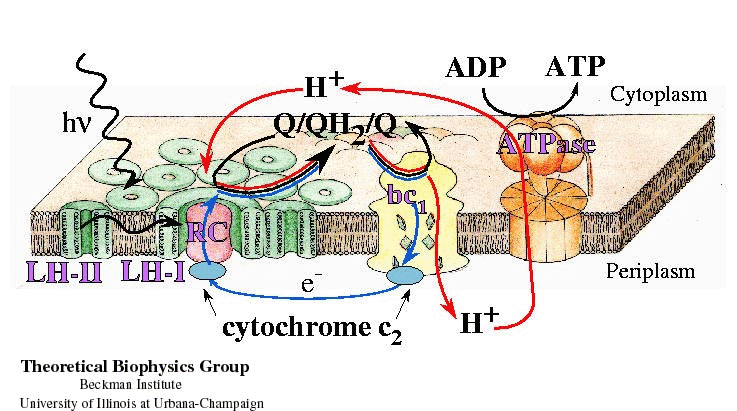
The figure presents the scheme of the integral membrane proteins forming the photosynthetic unit.

Now, a new kind of science, called “quantum biology,” is beginning to emerge –- and it could change everything we know.

And yet, it wasn’t until the nineties (2) that it was suggested biology could be better understood by looking at it through the lens of quantum theory. Not long after that, the idea caught on – particularly in the neurosciences, where the idea of the brain as a quantum computer quickly became a topic of fierce debate.

Investigations of dynamic molecular structure and energy transfer at the quantum level have credibility if they explain macroscopic biological observables that otherwise are inexplicable, says Wikipedia article. Why so? It must also explain normal biology. After all everything is made up from quantum particles. The atom is no definitive border. All living materia is only illusionary stable. In fact atoms is transported in and out all the time. Also the chromosomes are changed a little, but they are still quite conserved, actively. The germ-line is also protected (also from the quantum biology), as is the brain (by tight junctions). The self-organization is the process that maintain the illusory picture of an iniert body. We all know we are not the same individual when we are born and when we die.

Frequence-specific absorption
Some of the biological phenomena that have been studied in terms of quantum processes are the absorbance of frequency-specific radiation (i.e., olfaction and here, hearing, taste, and vision) Also mecanosenses in the body; the conversion of chemical energy into motion; magnetoreception in animals and brownian motors in many cellular processes. Above all quantum biology unites these perceptions. Here a long list to study.

Chemical transformations
Biological processes that involve the conversion of energy into forms that are usable for chemical transformations are quantum mechanical in its nature. These processes involve chemical reactions themselves, light absorption, formation of excited electronic states, transfer of excitation energy, transfer of electrons and protons, etc.

Some other biological processes, e.g. orientation of birds in the magnetic field of Earth, and bee dance, have been also suggested to require quantum mechanics. Also analysis of magnetic fields, and may possibly shed light on Circadian rhythms etc.

Quantum biochemistry
Photosynthesis and oxidative respiration have produced significant, verifiable results. In particular the step-wise, quantum release of protons upon photon absorption linked to water `splitting' in photosynthesis requires a quantum theoretical explanation involving complex photosystem II.
Enzyme reactions involve quantum tunnelling mechanisms, highlighted by both experimental and theoretical studies in enzyme-catalysed hydrogen transfer. What is the physical basis of the phenomenal rate enhancements achieved by enzymes? Reorganization energy electron /proton tunnelling etc.
Chemical transformations that involve the conversion of energy with phase transitions for instance. These processes involve chemical reactions, light absorption, formation of excited electronic states, transfer of excitation energy, etc. Quantum biology uses mathematical computation in biological tissues to model biological interactions.
Membrane interactionsas with phospholipase A2 enzyme. The coupling between the quantum proton and the classical atoms is done as well as the time dependence of the potential energy function. The mechanism of surface activation is in focus. It is activated in some way when it interacts with aggregated forms of the substrate, such as in micelles or in bilayers. Electrostatic and hydrophobic interactions are suspected to be involved in the binding of the enzyme to the membrane. Very little is known of the enzyme-membrane complex structure and why the enzyme reacts much more efficiently once it binds its substrates in an aggregated form.
Free radicals already 1961. Signals having an absorption and emission character were observed in the 12-5 MHz–18 MHz frequency band in the direction parallel to the external magnetic field.
The function of membrane proteins often depends on the proteins interaction with their lipid environment, spectacularly so in the case of mechanosensitive channels, which are gated through tension mediated by the surrounding lipids.
Quantum genetics. An unresolved and still controversial issue in this field is that of non-trivial (i.e. not limited to properties of molecules) role of quantum effects in biological systems. However recent studies of transcription are consistent with quantum information processing of coherent duplex DNA states by the transcriptase.
Receptorfunction, as aquaporins, gap junctions and GPCR-receptors show quantum mechanical functions with phase transitions.
The nerve pulse according to soliton model is quantum mechanical.

Coherence and synergism
“God does not play dice”, is a famous Einsteinian lapsus. Quantum mechanics is magic.
Is the moon there when nobody looks? "During a walk Einstein suddenly stopped, turned and asked whether I really believed that the moon exists only when I look at it." Would we know if moon was never observed?

All the parts of an organism “are multidimensionally, dynamically, and almost instantly correlated with all other parts”. What happens to a cell or an organ will influence all the other cells and organs. We may here talk about an organic correlation which may correspond to the phenomenon of entanglement in quantum physics. The organism is also coherent with its surroundings, and the external environment is reflected in its interior. It is due to this coherence that the organism may develop in harmony with its environment.

Water as coherence mediator
The quantum coherence of organisms arises from the unique ability of living systems to store and mobilise energy with zero entropy in the ideal, and depends to a large extent on the liquid crystalline water matrix that enables each molecule to intercommunicate with every other, creating the most exquisite ‘quantum jazz’ of light and sound displays that span 70 octaves in all the colours of the rainbow, says Ho (4).

The quantum coherence of organisms profoundly revolutionises our concept of health and disease. The healthy quantum coherent state is reflected in the complex dynamics of biological rhythms that are correlated like an exquisite symphony. Consequently, loss of coherence (disease) can be diagnosed with appropriate mathematical tools. The organism coordinates its activities by coherent electro-dynamical inter-communications, in which the quantum coherence of water plays a central role. That is why the organism is hypersensitive to weak electromagnetic fields and other subtle energy interventions.
Liquid crystalline matrix permeates throughout the connective tissues and into the interior of every single cell by microtubulis and cytoskeleton, as a communicative network, just like the nervous systems. The water molecules are aligned in ordered layers along the extensive surfaces of macromolecules and are an integral part of the liquid crystalline continuum. It makes the living matrix highly responsive to changes in pressure, temperature, pH, and electrical polarization. The ordered layers of water in the matrix also support a special kind of piezoelectric ‘jump conduction' of protons that is much faster than nerve conduction and faster than ordinary electrical conduction through wires.
The dynamically ordered layers of water molecules are associated with the oriented collagen fibres in the connective tissue and correspond to the acupuncture meridians, which are a low dielectric communication network system that also react on lowfrequency EM-waves in environment.

The observer
“Observations not only disturb what has to be measured, they produce it…. We compel [the electron] to assume a definite position…. We ourselves produce the results of measurements. ”Pascual Jordan.

With recent developments in physics, and phenomenon like ‘entanglement’ there is no longer reason not to include research of parapsychology into our scientific understanding of reality. Psi-effects must be understood as very weak effects similar to the observer-effects. But are Psi reality? Or are it an effect of the consciousness when we whish something or look at something. It is noticed that without a perceptional feedback there is no Psi either. Compare to biofeedback. "Is the moon there if nobody looks?"

The Computation
This strange behaviour of light can be perfectly described by considering probability amplitudes instead of probabilities, and probability amplitudes change when unobserved, indistinguishable alternatives become distinguishable. And this can lead to paradoxical situations such as quantum ‘seeing in the dark’, or getting information about something without light ever reaching it.

Probability amplitudes give probabilities when squared, and the rule for combining them was discovered by quantum physicist Richard Feynman. Feynman’s rule says that if an event can happen in two or more indistinguishable ways, the probability amplitude for that event is the ‘sum’ of the probability amplitudes for each way considered separately. The final probability of an event is then obtained by the sum of the squares of the two numbers describing the resultant probability amplitude. Feynman’s rule is Pythagora’s theorem: a2 + b2 = c2, which tells us how to obtain the length of the hypotenuse of a right-angled triangle from the lengths of the two sides. We learned that in elementary Euclidean geometry in school. It seems that Euclidean geometry enters fundamentally into quantum reality. But why should that be? "Nobody knows how it can be like that," said Feynman.

CP-violation, chirality, spinors and twistors, the EPR-paradox, Bells theorem and Gauss probability, hidden variable theory, are behind such phenomens as consistency, coherence, entanglement, correlation, and also consciousness, phase transitions. Also the time conception is changing. Time is a part of correlation too. Maybe we can change our history, at least our own. Time travel is not completely ruled out.

Quantum computing depends above all, on the coherent entangled state over time, or pure state that contains the superposition of multiple, even mutually exclusive alternatives. The more alternatives are entangled, the faster the quantum computing (braiding). It is the ability to ask many questions all at once, rather than one question at a time.

Quantum coherence is the basis of living organisation. The coherence of organisms is actively maintained, and extends, in the ideal, over all space-time scales. Could the organism be the model of the quantum computer that quantum physicists are trying to build? Could it be that proteins in the body fold to perfection in split seconds because the process involves quantum computing via infinitely many entangled states that encompass the entire body (5)?

Will a quantum hyper-computer take over the world? Will it simulate a human being so exactly that it is a hyper-intelligent human being? Well, if it starts to laugh at jokes I’d be worried. And if it can really simulate perfectly a human being, we better start setting a good example. Otherwise it has every chance of turning out to be a power-hungry despot intent on enslaving the whole world (6).

Predictability
Erwin Schröedinger (1944), in What Is Life? introduced the idea of an "aperiodic crystal" that contained genetic information in its configuration of covalent chemical bonds. At that time DNA was not yet accepted as the carrier of hereditary information, which only was the case after the Hershey-Chase experiment of 1952. "How can the events in space and time which take place within the spatial boundary of a living organism be accounted for by physics and chemistry?’ He continues, ‘the preliminary answer which this little book will endeavor to expound and establish can be summarized as follows: the obvious inability of present-day physics and chemistry to account for such events is no reason at all for doubting that they can be accounted for by those scientists.’

Consciousness is quantum biology
How to incorporate altered states of consciousness within a new paradigm? This is a key problem for consciousness and quantum biology, says Rakovic and Dugic (7). It is the famous body/mind problem, that in all times has engaged the philosophers. The electromagnetic (EM) component of ultralowfrequency (ULF or ELF) "brainwaves" appears to enable perfect fitting with narrowed down limits of conscious capacity in normal awake states, and those frequencies are used as stabilizating and organizating agents. An additional low-dielectric, weakly ionized neural network ('quantum holographic neural network-like acupuncture system') is necessary in these processes.
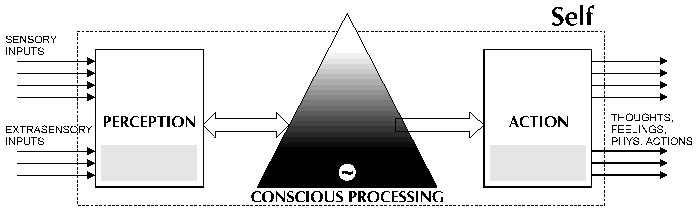
Fig.2. (6) Generalized psycho-physiological model of the Self. Extreme states of consciousness are mostly related to the modified functionality of Perception block. Its output is changed by overloading senses, sensory deprivation or by changing its functionality (drug admission for example). Having in mind that during these states Action block exhibits rather altered output than its cessation, we can draw a conclusion that our model must have either internal generator or set of inputs that is not dependent on senses.

A comprehensive theory of consciousness must explain, not only self-awareness, intention, sensation, perception, memory, cognition, learning, creativity, curiosity, and altered states, but life per se, quantum entanglement, telepathy, precognition, energy healing, the evolution of species, and the homing behavior of pigeons and other animals. A theory that describes this polymorphous set is founded on the concept that all of its elements are products of holistic systems (8). Holistic systems are quantum systems and through its non-locality they organize Nature.

It would not be beyond the pale to suggest that our ‘consciousness’- think of it as our coherent quantum field - could become entangled with that of water, thereby influencing the structure of the water. Some 99% of all the molecules in our body are water in any case (9).

That is, a theory of consciousness is a general theory of organization and holistic systems. Quantum biology can't be kept apart from consciousness because it is the essence of life.

References (a few, more in the links in text)
1. Vilhelm Schjelderup 1974: Legekunsten på nye veier.
2. D.V. Nanopoulos’ Theory of brain function, quantum mechanics and superstrings. seminal paper.
3. Erwin Schröedinger 1944: What Is Life?
4. Mae-Wan Ho 2005: Acupuncture, Coherent Energy and Liquid Crystalline Meridians. Second International Congress on Acupuncture, 3-5 June 2005, Barcelona, Spain
5. Mae-Wan Ho 2001: Quantum Computer? Is It Alive?. ISIS Review -15 October 2001.
in: The Feynman Processor, Quantum Entanglement and The Computing Revolution, by Gerard J. Milburn, Perseus Books, Cambridge, Mass, 1998, ISBN 0-7382-0173-1. http://www.i-sis.org.uk/QuantumComputing.php
6. Emil Jovanov : On The Methodology Of EEG Analysis During Altered States Of Consciousness. http://www.vxm.com/21R.94.html
7. Dejan Rakovic and Miroljub Dugic 2001: CONSCIOUSNESS MEDIATED QUANTUM GRAVITATIONAL COLLAPSE VIA GENERATED WORMHOLES: FROM MACROSCOPIC BIOPHYSICAL TO MICROSCOPIC QUANTUM ARGUMENTShttp://www.vxm.com/Link.DejanWormholes.html
8. Watson E.D. et.al.(Donald E. Watson, Gary E. R. Schwartz, and Linda G. S. Russek) 2000: The Theory of Enformed Systems: A Paradigm of Organization and Holistic Systems. http://www.vxm.com/link.enformytheory.html
9. Mae Wan Ho http://www.i-sis.org.uk/water4.php

söndag 1 november 2009

Order in living systems

Where come the order in living systems from? And you think I must answer that when nobody else can? Well, I'll try. This is very simple and a result of many years of collections and reflections.

Living systems are extraordinary just in their capacity to collect order from outside their body, but they have also a self-organizing capacity, that is to keep that order.

We collect order through our senses and perception, and one of the most important and also oldest sense is olfaction. We have six senses incl. ESP = extra sensory perception. I tried to explain that collection in the perception of odor, and thought it was a good example because it was so complicated that the nerves alone can't explain it. We must explain it through quantum biology and the notion of a 'magnetic body'.

Perception and 'I'
But if we take ESP, that is without any known sense, how can we sample that order then? It must have a perception, that is, go to brain. Or can we have a perception without brain? Of course we can. Unicellular oganisms have a perception, and an 'I' too. The notion of perception and 'I' is very close.
Can we have a perception without 'I'? If we think of an unicellular life it is perhaps difficult. Then everything is reflexes, without free will. But if we think of a schizophrenic? He has a free will, but that will is overruled by something else. That 'else' is stronger than the free will. But of course he has perceptions, that is collecting of order, but it is without meaning to him. The order is not 'his' order. And so his self-organization is disturbed. His 'I' is too weak, and the sorting out of 'noise' is then also too weak.

The same can be said of many deseases. Something unwanted is sampled and so follow a breakdown of self-organization, often only temorarily. After that disturbance the 'I' is stronger. The goal is to have a strong 'I'. In that way all deseases can be seen as an allostatic reaction. As we become older that self-organizing capacity is weakened, more for active parts of our body, because the telomeres are shortened faster there. Kinases and telomeres have a close relation of some kind.

Patients in coma is said to be without perceptions, but it is not true. They react and they can even remember sometimes. It is only their consciousness or rather awareness that is gone. The pain too, and many of the reactions that belong to the 'I'. I think it is important to keep the awareness and consciousness apart, because it is two entirely different things.

Homeostasis and allostasis
That self-organization can also be disturbed from inside the body. In fact it is often the case. Psychic conditions, as panic disorders, are often behind that too. But not schizophrenia. It is a disturbed collection from outside because the 'I' is too weak, panic is a disturbed reaction of the 'I'. Too much selfprotection? Some have said that all diseases are psychosomatic, but it is perhaps too strongly said, but at least 80% of all.

Or take some hydrocephalics. The brain is very damaged, but they percept. The inner parts of the brain is there. So what do we need our brains to? This is a question that has long bothered me. An answer came in the notion of a rigid map in our brains. Of course it must be rigid, because our brain is a structural mirror of our body, but a fractal, hierarchial and topological one, very compressed. The rigid map of our scent is like a piano, and the music comes from the odor perceptions at the different receptors. Like a light flickering at different tangents.

What is the brain good for?
Rigid maps are also shown for a hand in the motor area. When a finger is lost, also the finger in the brain is gradually lost. Brain change a little all the time. And for sight too there is a rigid grid. The brain is simply a reference frame for the 'I'.

Do we need the brain for something else? Yes, for inhibition and diminishing of all the various samled orders that come from outside. For the brace-effect, not to become overloaded of the orders. To choose the order that has a meaning for the free will of 'I'.

And of course for thinking. 'I think, therefore I am', is a famous cit. Our thoughts is flickering at those tangents too, just as the perceptions from our body. But our thoughts (in as...if loops acc. to Damasio) is much more compressed than our brain, if we think at the working memory. Also our awareness is compressed from our consciousness.

The 'I' use the brain as a reference frame and those perceptions and memories as a tool for its thinking. It is 'I' that think, not the brain, because it is rigid. Who is 'I' then? It is holistic. It is a mirror projection from our chromosomes where the genes are only about 5%. It is a mirror from all those fractal pictures of 'I'. But 'I' is not in our body. We can easily loose an arm or a leg, and we are still the same 'I'. In fact we can loose our whole body and still be almost the same. Paralysis from the neck downwards has been shown to compress our self a little, but not much. But then we have still our gut stomach left, our 'second brain'. It percieves and feels. In fact Damasio has shown that if nerves are cut in the brainstem we still have our consciousness if the lesion is done under the site where trigeminus nerve encounter. We need input from our body, if then only as the bodymirror of our topological and fractal face-image. The consciousness comes from our body?

Who is the 'I' in our brain? It is not in our structure, but that flickering light, so the light comes from our body and our thoughts. But it can come from the outside too, shown as PSI in ESP. PSI, Chi and subtle energy is the same thing.

Meridians
Chi circles in our meridians. It consists of three parts acc. to the TCM, of which one can be called 'soul'. Meridians is a misnomer, it should be called channels, because it is a channel system in the same way as blood, lympha and nerves. In fact it is in touch with those other channel systems, because an acupuncture is where a nerv, a bloodchannel and a chi-channel meet. Chi-channels is loose connective tissue and builds a sheet in one piece for communication, and it use gap junctions probably. See this. The connective sheat has pockets for organs and muscles etc. If only the connective tissue is left the whole body structure would still be seen. This connective tissue is in contact with the cytoskeleton and the microtubuli network. The chi-channels are very old, from the time when life encountered land. From the same time as the olfactory sense and the eikosanoid-cascades. Also the serotonin-cycles. And it is also probably so, that chi-channels and the gliacells are the same thing, so then the chi-channels lies behind the nerve systems and also the nerve pulse. Is that Chi coming from outside our 'I'? Our soul?

Now it is shown that the chi-channels collect order from outside. It is done from the geomagnetic force field of Earth, in terms of Schumann frequencies. So suddenly the 'I' is the whole Earth, or nonlocal. That is dark energy or magnetism. In fact experiments with magnetism has some very profound effects pointing to the same conclusion. The 'I' can collect order from the whole Earth, and disorder too. Also that is shown in sun'storms'. Studies in parapsychology is very interesting in this context.

So, we can say we have a 'shadow'individual that can be very big. You know, that magnetic body. Or symbolically the aura fields in metaphysics. From symmetrial point this is a very satisfying solution too.

Memory and magnetic body
Then we have the memory. Nobody has shown it is in our brain, only short-term memories. In sleeping those short-term memories are translocated somewhere else?. They are found in our PFC area. But only some of them.
In sleeping the serotonin is also decayed and some of it is changed to methionin. Our stomach is producing a lot more methionin than our epiphyse. Why must serotonin be decayed? Because it is something that keep us alarmed. Its frequence is about 10 Hz, about the same as main Schumann and alpha brainwaves, but in sleeping the EEG is lowered much more. Methionin is also an antioxidant. Radicals and antioxidants are magnetic molecules.

People doing 'readings' can 'read' your aura. They can 'feel' your memories, emotions, everything almost. But only in a very small area, as if they looked at the aura through a small keyhole. How can they see your memories, if they are not outside the body? The memories are translocated out of body, drifting out, in the magnetic field around us? That field is also seen in the 'Kirlian' effect or the 'irisdiagnostics'. It can in fact be seen in the whole body as weak parts. It is that magnetic 'field' that acts as a reflex on our physical body, and our physical body acts as a reflex on our magnetic 'field', a two-way system.

That is called our magnetic body by Matti. Certainly he has objections against this picture:-) Magnetic body is not only a field, it is something wider, a body of dark matter. Nobody can tell us yet what dark matter is.

Where come that order from?
This is a big question, and I can only give some reflections.

We sample order from the whole Earth, also from Sun and the Cosmos. We can read that energy as impact from Moon, Sun and Cosmos in 'storms'. That is very much as disturbances. But it also give us information.

The more important part of the information is sampled from Earth in form of a stable pulse that regulate our biology and life as a whole. This pulse is non-local or magnetic. It is also immaterial. It can interfere with our emotions. It is very important for us to have a stable regulating pulse.

Now that order is negentropy. It is thought that order is a function of disorder, which is growing. But living systems collect order and work against the entropy laws. The living systems is too creating heat and in that way increasing the disorder in Universe. This heat increase is without importance, when there are whole galaxies that is very hot. Also our sun is very hot. The greenhouse effect is too quite small, but have still some minor effects. Most of the effect comes from our sun, I think. The growing electromagnetic pollution is also a problem, that can have impacts on our regulating earth-pulse.

Consciousness
Why do we collect negentropy? Negentropy is 'dark'. We need it for the self-organization, but also for our consciousness. The sum of consciousness worldwide is growing, and we need consciousness badly to meet up with all supercomputers and quantumcomputers soon invading us. We need a very strong ability to sort out the essential information, and it can't be done without increase in consciousness. The higher hbar, as Matti says:-) A widening of consciousness is use of more 'bits' of information in a holistic way. True wisdom or gnosis.

Where is most of the holistic information? In our bodies. We need to be conscious of our bodies, to read our different messages in form of emotions, feelings, senses etc.. But also in reading negentropy from the outer world. To sample information 'subconsciously'. To develope that ESP-sense. I think that's the future goal.

Evolution
Forces behind the evolution is of course two, entropy and negentropy; Darwin and Wallace; war or piece; concurring or social working together. It could perhaps even be thought of as luminous matter and dark matter? In that way evolution would be an condensation maximation of dark matter. That is the same thing as Lamarck spoke of as a 'climbing up the ladder of complexity', or today as a differentation and specialization. Interestingly the 'necessity' principle was strong in alchemy. Something was done because there was a need for it. I think we have forgotten this fact today. In ecology it is 'empty nishes'. The 'necessity-principle' is born when the spacetime sheat widens?

The observer effect
Also some words about it. It is a very weak PSI-effect and a reflection of dark matter. It is too a two-way mirror-image between luminous and dark matter. It is one of the still unsolved laws and mysteries in life. Perhaps Nielsen at the danish Bohr-institute has come up with a probable solution. A law behind the second law of thermodynamics; a law of Karma.

References: The interested reader can ask for references. They are too many to be listed here. And to give only a few would give a wrong impression. Therefore I leave the field empty.

torsdag 29 oktober 2009

Perception is quantum biology

Animals have to recognize a multitude of odorous substances related to food, predators, mating partners, health status, genetic individuality, group status etc. Accordingly, their sense of smell has the capacity to detect and discriminate an almost unlimited number of odors. But that is not all. Detecting and discrimination is just one piece of the cake. The other is how that information is interpreted (in the brain), or perception. How emotions, behaviour, desires, disgust, desisionmaking and so on comes out from that odor or smell. The first problem is gene-related, the second brain-related. By far the most important of these is the perception of odors.

Model of an odor receptor, a GCPR-receptor. Comparison of the predicted binding sites for GPCRs: white, bovine rhodopsin; green, rat I7 OR; blue, mouse I7 OR; red, β1AR. No clear mechanism is known for the message transmission. A suggestion: After the ligand is bound, the extracellular loop 2 may close down over the barrel. The dramatic movement of EC2 in response to ligand binding may cause helix 3 to translate in the cytoplasmic direction, exposing the D(E)RY sequence to the cytoplasmic region near the G protein. This might initiate the signal transduction pathway, and the involvement of second messenger pathways (amplifying cascade).

A sensory input has a 'what is it?', and a quality question 'how' or 'is this good?' and those questions come (almost) together. This is the eg. sensory input and the qualia-problem of that input. How our self interpret that smell. This happens automatically, without any conscious desisionmaking. But is this interpretion in the brain or already in the sensory receptors/neurons? Now the olfactory area in the brain is very near the receptors, so it is perhaps not so big difference. In fact all of our 'big' senses are in our head, seeing, hearing, tasting, smelling. It is only 'touch', or somatic sensory receptors, that is not. Is 'touch' then interpreted in another way than the 'top senses'? Are there a hierarchy in sensory inputs? The outcome is often depending on all senses, but in different degrees. Maybe the different evolutionary sensory ages lies behind that hierarchy? Olfaction sense is very old, says a look at the genes. Also bacterias have the same genes. The function of pseudogenes is also unclear.

'Sensory qualia are assigned to the sensory receptors rather than to the neural circuitry of brain as in standard neuroscience' says Matti Pitkänen. 'The identification of qualia follows from the identification of quantum jump as a moment of consciousness. Just as quantum numbers characterize the physical state, the increments of quantum numbers characterize the quantum jump between two states. This leads to a capacitor model of the sensory receptor in which the sensory perception corresponds to a generalized di-electric breakdown in which various particles carrying some quantum numbers flow between electrodes and the change of the quantum numbers at second electrodes gives rise to the sensory quale.'

Pitkänen has also proposed frequency coding for the sensory qualia. Frequencies code provide only a symbolic representations - define their names - as one might say. The information about qualia and more general sensory data would be represented in terms of cyclotron frequencies inducing dynamical patterns of the cyclotron Bose-Einstein condensates of biologically important ions residing at the magnetic body receiving the sensory information (I talk more of this later).

Quantum biology
'Welcome to the strange new world of quantum biology', says Graham Fleming in 'Is Quantum Mechanics Controlling Your Thoughts?'. 'Quantum mechanics and the biological sciences do not mix. Biology focuses on larger-scale processes, from molecular interactions between proteins and DNA up to the behavior of organisms as a whole; quantum mechanics describes the often-strange nature of electrons, protons, muons, and quarks—the smallest of the small. Many events in biology are considered straightforward, with one reaction begetting another in a linear, predictable way. By contrast, quantum mechanics is fuzzy because when the world is observed at the subatomic scale, it is apparent that particles are also waves: A dancing electron is both a tangible nugget and an oscillation of energy. (Larger objects also exist in particle and wave form, but the effect is not noticeable in the macroscopic world.)'

Is it really so that the worlds don't mix? How sensitive can a receptor be? It is a big protein though. Protons are known to give a respons, but electrons are far to small? Proton-coupled electron transfer (PCET), especially prevalent at metallo-cofactors that activate substrates at carbon, oxygen, nitrogen and sulphur atoms maybe? Those free radicals again.

Different models of olfaction.
The prevailing notion is that the sensation of different smells is triggered when molecules called odorants fit into receptors like 3-D puzzle pieces snapping into place; the key and lock models. When probed by a biological system, shape now translates into the sum total of all the repulsive and attractive interactions that a molecule 'feels' when bound to a receptor: exchange repulsion plus hydrogen bond donors and acceptors, lone pairs, etc.. But molecules with similar shapes do not necessarily smell the same. It is not only a question about 3-D. While odorant shape and size are important, experiment indicates these are insufficient. Isomeri, carbon chain structure, functional and end groups, metals etc. are also important.

One so far speculative model suggests inelastic electron tunneling from a donor to an acceptor mediated by the odorant actuates a receptor, and provides critical discrimination; the swipe card model, or vibrational spectrum of the odorant (Dyson 1938), reproposed by Luca Turin. Recognition and actuation involve size and shape, but also exploit other processes.

Receptors perform an act of quantum tunneling when a new odorant enters the nostril and reaches the olfactory nerve. After the odorant attaches to one of the nerve’s receptors, electrons from that receptor tunnel through the odorant, jiggling it back and forth. In this view, the odorant’s unique pattern of vibration is what makes a rose smell rosy and a wet dog smell wet-doggy.

The vibrational theory has been given the thumbs up by a team of physicists, says a Nature article 2006, Rogue theory of smell gets a boost.

The problem is intensity and background, perception is learned, says Wilson & Stevenson. The psychological side of odors are very poorly known. They say: 'The discovey of a large gene family coding for odor receptors 1991 (Buck & Axel) has led some to conclude that perception happens at the receptor sheet and that knowing of the pattern of the receptors afferent activity will predict the perception.'
Brennan & Kendrick says: Many of these signals take the form of complex mixtures and have important influences on a variety of behaviours, attracting interest and approach, that are vital for reproductive success, such as parent-offspring attachment, mate choice and territorial marking. Chemosignals with relatively high volatility can be used to signal at a distance and are sensed by the main olfactory system. Most mammals also possess a vomeronasal system, which is specialized to detect relatively non-volatile chemosensory cues following direct contact. Single attractant molecules are sensed by highly specific receptors using a labelled line pathway. These act alongside more complex mixtures of signals (based on the highly polymorphic genes of the major histocompatibility complex) that are required to signal individual identity. Thus robust systems for olfactory learning and recognition of chemosensory individuality have evolved, often associated with major life events, such as mating, parturition or neonatal development. In the accessory olfactory bulb, memory formation is hypothesized to involve a selective inhibition. Information is integrated at the level of the corticomedial amygdala, which forms the most important pathway by which social odours mediate their behavioural and physiological effects. Indeed, mammals could also learn odours associated with maternal MHC type in utero.

The receptors
Studies of the relationship between molecular shape and odor were earlier made without reference to the biological sensor. The discovery 1991 that the olfactory receptors were seventransmembrane helix proteins (7-TM), GCPR:s, finally brought this problem into focus.

'Olfactory receptors (GCPR:s) play a key role for a reliable recognition and an accurate processing of chemosensory information,' says Fleischer et.al. in 'Mammalian olfactory receptors'. 'They are therefore considered as key elements for an understanding of the principles and mechanisms underlying the sense of smell. The repertoire of olfactory receptors in mammals encompasses hundreds of different receptor types which are highly diverse and expressed in distinct subcompartments of the nose. Accordingly, they are categorized into several receptor families, including odorant receptors (ORs), vomeronasal receptors (V1Rs and V2Rs), trace amine-associated receptors (TAARs), formyl peptide receptors (FPRs), and the membrane guanylyl cyclase GC-D. This large and complex receptor repertoire is the basis for the enormous chemosensory capacity of the olfactory system.' The olfactory system is composed of several chemosensory subsystems, including the main olfactory epithelium (MOE), the vomeronasal organ (VNO), the septal organ (SO), and the Grueneberg ganglion (GG).

Different olfactory compartments in the nose express distinct types of olfactory receptors. The olfactory receptortypes expressed in each of these organs are indicated by color. The olfactory sensors is building a microsystem map (of the whole body), which is very sensually and 'sexy' ('good/bad').

Combinatorial receptor codes for odors
'We found that one OR recognizes multiple odorants and that one odorant is recognized by multiple ORs, but that different odorants are recognized by different combinations of ORs. Thus, the olfactory system uses a combinatorial receptor coding scheme to encode odor identities. Our studies also indicate that slight alterations in an odorant, or a change in its concentration, can change its "code," potentially explaining how such changes can alter perceived odor quality, say Malnic et.al. Individual olfactory neurons are responsive to qualitatively distinct odor compounds too.

Further, the olfactory system forms a unique spatial organization such that the axons of olfactory neurons expressing the same receptor converge onto fixed glomeruli of the main olfactory bulb (MOB). The type of activated receptors in the olfactory epithelium directly reflect the receptive field in the olfactory bulb, where they provide input to the primary dendrites of mitral and tufted cell projection neurons. Each glomerulus receives input from a single receptor type and therefore acts as a fundamental unit of odour representation. The result is a simple map. Accessory olfactory bulb mitral cells respond selectively to the strain identity of stimulus animals. Significant excitatory responses are indicated in red and significant inhibitory responses are indicated in green, in this fig. That is the 'good' signal is discriminated from the 'bad' already in the bulb, through a 'grid system'. Probabilities and quantum mechanic is used to compute this?

Communication
GPCRs mediate our sense of vision, smell, taste, and somatic sensations. They are also involved in cell recognition and communication processes, and hence have emerged as a prominent superfamily for drug targets. Half the GCPR:s are nonsensory communicative receptors, and mediates diverse physiological stimuli such as light, hormones, and neurotransmitters.

The receptor code for an odorant changes at different odorant concentrations, consistent with our experience. This concentration gradient can perhaps be explained by quantum tunnelling, where a small force give no or just a little transfer of information. See an animation of this. In ordinary biology it is explained by changing receptor sensitivity. 'At a low concentration of the odorant, only the receptor A recognizes the odorant, but at increased concentrations, more receptors can recognize the odorant, implicating that the encoding of the odorant changes at different concentrations.'

According to the old shape theory, discrimination at the level of olfactory receptors correlates with the receptive field in the olfactory bulb in brain, where the input signal is further processed, to create the specific odor maps in brain. The combination of sensory neuron specificity and the pattern of firing activity and the Ca-waves, appears to contribute to reconstruction of the information into a unified conscious perception in the CNS. Apparently, the perception of external signals and the correspondence of those signals in the physical world, is essential for most species across phyla to organize their various behaviors and processes.

Functional responses of single olfactory neurons can be seen in EEG-pattern, when actionpotentials and Ca-waves are generated upon sensing. Once the chemical signal encoded by odorants from the physical world (in the dendritic tree) is converted to electrosignals in the receptor neurons, the information is transmitted as an on-off signal to the glomerulus, the olfactory bulb and ultimately to the olfactory cortex.

But these potentials is made up of many different types of receptors and somatic, reflexive maps in the nose, and of both 'what' and 'good/bad', or 'how', the quality information. In no way the 'good/bad' information can be emergent in the brain. Or can it?

'Although further sharp tuning of the specificity and the integration of signals from odorant receptors may occur in the olfactory bulb and cortex, the pattern created at the peripheral receptor neurons is fairly preserved in the course of signal processing. The receptor code scheme, therefore, plays the main role in contributing to the olfactory processing of odor molecule information', says Touhara 2002. And he continues, 'Since the receptor codes for odorants seem to mainly contribute to odor discrimination, the function of signal transmission in olfactory neurons is mainly to produce action potentials. In this context, it should not be necessary to have more than one signal transduction pathway. Indeed, gene knock-out studies suggested that the cAMP cascade comprised of three components (i.e., stimulatory G protein alpha subunits, adenylyl cyclase type III, and cyclic nucleotide-gated channels). Also IP3 is perhaps used as another pathway (observations of cross-talk between the two pathways = concertations), which would give complex signals. Odorant stimulation results in either excitatory or inhibitory responses of individual olfactory neurons.

Complex signals is suggested by Kaivarainen as a quantum computation tool.

Calcium imaging is another strategy for detecting physiological odorant responses of olfactory neurons by measuring the temporal and spatial properties of Ca2+ changes caused by odorant stimuli. Odorant stimulation causes Ca2+ entry through cyclic nucleotide-gated channels in individual responsive neurons, which is regulated by a series of signal transduction components as well as feedback mechanisms followed by odor adaptation of the activated cells.

Agonist - antagonist in odors
Functional evidence that the olfactory receptors indeed mediate odorant signals had not been provided for many years since the discovery of the superfamily 1991. Heterologous expression systems and the lack of antagonists were the main reasons. The pairing of receptor and ligand was difficult. The chimeric receptor approach has led to the identification of a number of ligands for several olfactory receptors in rats and humans (also taste). In fact are olfactory receptors found through the whole body, not only in the nose. Why? Do other cells too smell? Or can it be the phonon electron tunnelling as Turin suggest?

Despite increasing information on agonist–OR combinations, little is known about the antagonism of ORs in the mammalian olfactory system. Oka et.al. shows how odorants inhibit odorant responses of ORs; evidence of antagonism between odorants at the receptor level. The antagonism was also visualized at the level of the olfactory epithelium. Dual functions of odorants as an agonist and an antagonist to ORs indicate a new aspect in the receptor code determination for odorant mixtures that often give rise to novel perceptual qualities that are not present in each component. The encoding of an odorant quality is determined by a combination of ORs. A receptor code for an odorant mixture, therefore, is expected to be the sum of the codes for its components. The perceived magnitude of an odorant mixture was neither additive nor a simple average of its components, but instead fell between these limits, designated as masking (i.e. modification of perceived odor) or counteraction (i.e. reduction of odor intensity). Mixing some odorants led to the emergency of novel perceptual qualities that were not present in each component, suggesting that odorant mixture interactions occurred. There is evidence that odorant mixture interaction begins at the peripheral neurons. Odorants compete to bind the receptor sites and activate or antagonize olfactory neurons, resulting in a nonadditive receptor code (synergism/suppression). It describes a molecular aspect in the odor-recognition mechanism in the olfactory sensing system that always perceives odorants as a mixture in real life and results in the creation of a complex spatial odor map, which is eventually transmitted to the higher cortical areas of the brain where a conscious perception is constructed. 'Our pharmacological analyses of receptor antagonism in HEK293 cells and single olfactory neurons that expressed a defined OR clearly demonstrated that odorant mixture suppression occurred at the receptor level', says Oka et.al.

Zou et.al. revealed a stereotyped sensory map in the olfactory cortex in which signals from a particular receptor are targeted to specific clusters of neurons. Inputs from different receptors overlap spatially and could be combined in single neurons, potentially allowing for an integration of the components of an odorant's combinatorial receptor code. Signals from the same receptor are targeted to multiple olfactory cortical areas, permitting the parallel, and perhaps differential, processing of inputs from a single receptor before delivery to the neocortex and limbic system.

Also odorant decaying products may be used as antagonists.

Microtubulis computate.
In vision, color discrimination is produced by appropriate combinations of three 'types' of receptors that are each most sensitive to a different part of the visible spectrum (i.e., red, blue, and green). In gustatory sensation, five basic qualities (i.e., bitter, salty, sour, sweet, and umami) are detected by distinct 'classes' of receptors in taste cells. The olfactory system requires highly discriminative capabilities to distinguish thousands of different odorous chemicals. This must happen at receptor level, and be computated by microtubulis. 'Discrimination of various odorants seems to be performed primarily at the receptor level but not at the level of signaling pathways', says Toukara.

More of microtubulis and different frequential windows later.

'It would seem that either we have been blessed with supernatural luck or there is some correspondence between our calculations and odor character', says Turin about the developement of new perfumes (in Rational odorant design). 'What has changed from Dysons years is that we have gained a large database of odors and structures, and a vastly better understanding of the ways in which a ligand can interact with a receptor. What has not changed is our ignorance of the exact structure of the receptor, which makes proper modeling virtually impossible. Trial and error is still the main way to get a new odor. Using computers would be much easier.'

References.
Dyson, G. Malcolm (1938) The scientific basis of odor. Chemistry & Industry 57:647-51
Amoore, John E (1970). Molecular Basis of Odor. Springfield IL: Thomas
Wright, R.H. (1982) The sense of smell CRC press, Boca Raton, Florida, USA
Buck L and Axel R (1991) A novel multigene family may encode odorant receptors: a
molecular basis for odor recognition. Cell. 1991 Apr 5;65(1):175-87.
Turin L. (1996) A spectroscopic mechanism for primary olfactory reception. Chem Senses. Dec;21(6):773-91
Touhara K., 2002: Odor Discrimination by G Protein-Coupled Olfactory Receptors. MICROSCOPY RESEARCH AND TECHNIQUE 58(3):135–141. http://www3.interscience.wiley.com/cgi-bin/fulltext/97515771/PDFSTART
Oka Y. et. al. 2004: Olfactory receptor antagonism between odorants. EMBO J. 2004 January 14; 23(1): 120–126. http://www.ncbi.nlm.nih.gov/pmc/articles/PMC1271670/?tool=pubmed

And links in the text.

onsdag 12 augusti 2009

Vyöhyketerapiaa saatavilla Kauhajoella

Vyöhyketerapian avulla voidaan hoitaa monia erilaisia vaivoja sekä myös lievittää sairauksien aiheuttamia ongelmia. Ulla Mattfolkin kädet ovat oppineet lukemaan ihmisen kehon heijastuspisteitä, jotka ovat usein samalla myös akupisteitä. Kesäkuun puolivälin jälkeen Ulla on työskennellyt pääsääntöisesti Kauhajoella Topeekalla sijaitsevassa hoitotilassaan.

Hän on toiminut vuodesta 2002 lähtien dipl. vyöhyketerapeuttina. Aiemmin hän on myös työskennellyt mm. biologian opettajana.
– Minulla oli jo nuorena selkäongelmia, joiden vuoksi kävelykykyni heikentyi, ja myös halvaannuin pahimmassa vaiheessa. Toisen selkäleikkauksen jälkeen löysin asuinkunnastani Närpiöstä vyöhyketerapeutin. Hoito sattui aluksi, mutta sain avun ja tulos oli kuin ihme. Sitä kautta innostuin itse vyöhyketerapiasta, selventää Ulla Mattfolk.


Närpiöläinen Ulla Mattfolk avasi Kauhajoelle hoitopisteen. Vyöhyketerapian avulla hän kuvassa käsittelee asiakkaan jalkaleikkauksen jälkeisiä vaivoja.

Närpiön ohella nainen on työskennellyt myös Turussa, jossa hän aloitti tohtorin väitöskirjan teon kehon itseparannussysteemistä.
Kauhajoella hän tekee sekä koko kehon vyöhyketerapiaa että kasvovyöhyketerapiaa.
– Ihmiskehon hermosto on rakennettu niin, että syntyy koko kehon karttoja/ vyöhykkeiden muodostamia ”peilikuvia” vartalosta. Asia perustuu juuri hermostoissa oleviin reflekseihin.
– On olemassa sekä takaisin- että eteenpäin syötetyt refleksit, kuten vaikka kävellessä tietää käyttävänsä koko kehoa. Silloin aivon sensoriseen keskukseen tulee sisään ärsyke, joka käsitellään aivoissa, sitten se kiertää etulohkoon, ja sieltä motorisen keskuksen kautta ulos, Ulla selittää.

Näin ollen syntyy hermoärsykekiertoja kehossa, ja hoidossa juuri kyseiset kierrot voidaan käyttää tasapainon aikaansaamiseksi kehossa.

Apua monenlaisiin vaivoihin
Vyöhyketerapian avulla saadaan apua muun muassa fibromyalgiaan, verenkiertohäiriöihin, useisiin naisten ja miesten hormonaalisiin vaivoihin, mahavaivoihin, niska- ja hartiaongelmiin, migreeniin sekä astmaan. Ehdottomasti yleisin syy tulla hoitoon on kipu sen erilaisissa muodoissa.
– Astma on tauti, jota ei voi parantaa, mutta sen oireita voidaan vyöhyketerapialla tehokkaasti lievittää. Silloin hoidetaan polvesta alaspäin olevia sekä käsissä olevia heijastuspisteitä.
Diabeetikoiden kohdalla tärkeä painopistealue on jalkojen huonon verenkierron lievittäminen.

Kasvovyöhyketerapia
Ennen hoidon aloittamista Ulla menee potilaan henkilökohtaiset tausta-asiat lävitse. Hoidon kannalta on tärkeää tietää mahdollisista lääkityksistä. Kortisonin tai muun immuunijärjestelmään vaikuttavan lääkityksen aikana ei voi hoitaa, eikä kuumeisena.
– Jos on sydämentahdistin, keinonivel tms., ei niihin liittyviä heijastuspisteitä saa hoitaa. Koko kehon vyöhyketerapiaa ei saa myöskään tehdä epilepsiaa sairastaville ihmisille, koska hoito voi vaikuttaa niihin kohteisiin, jotka ovat vaurioituneita aivoissa.

Ulla Mattfolk lisää, että kasvovyöhyketerapia soveltuu epileptikoillekin. Siinä hoidetaan hellävaraisesti vain kasvohermoja, vaikka vaikutus ulottuu koko kehoon. Kasvovyöhyketerapia on lähes 30 vuoden kehitys- ja tutkimustyön tulos.
– Sitä on tehty Suomessa 2005 lähtien, jolloin minä olin täällä ensimmäisten joukossa saamassa siihen koulutuksen.

Kasvovyöhyketerapia on hyväksytty käytettäväksi koko Tanskan sairaaloissa.
Ulla kertoo keskimääräisen hoitokerran kestävän aikuisilla noin tunnin ajan ja lapsilla puolisen tuntia. Ulla Mattfolk (050–435 2723) työskentelee tällä hetkellä Hoitola Terveyttä Käsillä Sirpa Jaakkolan vieressä olevissa omissa tiloissa. Ulla mainitsee aikanaan siirtyvänsä Sirpa Jaakkolan idean pohjalta Kauhajoelle toteutettavan hoitokeskuksen tiloihin. –j-pl-r-

måndag 10 augusti 2009

Chakras and the colors II. Love and pain.

Light in our biology, in our head.
Are there anything in the biology that possibly could explain this light to us? The light gives euphoria, joy, love, strength, wisdom. It is a psychedelic drug. In biology we know of endorphins giving pleasure, phenethylamine PEA is addicting in love, sex stimulates the release of vasopressin and oxytocin, DMT makes you see God, and so on.

So, I read an interesting paper. Coordination involves a subtle kind of ballet in the brain, and like dancers, cortical areas are capable of coming together as an ensemble (integration) while still exhibiting a tendency to do their own thing (segregation). What? Quantum biology in working?
Because of the fourth dimension afforded by this colorimetric method, it is possible to observe and interpret oscillatory activity of the entire brain as it evolves in time, millisecond by millisecond, and show how to tell apart real and false episodes of synchronization. For the first time, true episodes of brain coordination can be spotted directly in EEG records and carefully analyzed.

The brain areas active in love are different from the areas activated in other emotional states, such as fear and anger. Parts of the brain that are in love include the one responsible for gut feelings, and the ones which generate the euphoria induced by drugs such as cocaine. So the brains deeply in love do not look like those experiencing strong emotions, but instead like those of people snorting coke. Love, in other words, uses the neural mechanisms that are activated during the process of addiction.

Strong social bonds depends on the receptors for vasopressin and oxytocin. Evolution acts on the distribution of these receptors to generate social behavior. The more receptors located in regions associated with reward, the more rewarding social interactions become. There are variations between individuals. But once romantic love begins, it is one of the strongest drives on Earth. This power is enough to warp judgment in otherwise sensible people. Althruism is also a social bond, or a freeing from the singular I.

Some suggest this mental state might share neurochemical characteristics with the manic phase of manic depression. Means love can be "treated" pharmacologically (serotonin-inhibitors)? It might even to be possible to create a more sociable human? And what about a more loving one? A few people even think that “paradise-engineering” is possible?

The experience of romantic attraction activates those sites in the brain with a high concentration of receptors for dopamine, closely tied to states of euphoria, craving and addiction. "The brain activity pattern is markedly different from when they looked at a picture of a close friend," reported neurobiologists Andreas Bartels and Semir Zeki. They linked high levels of dopamine and norepinephrine to heightened attention and short-term memory, hyperactivity, sleeplessness and goal-oriented behavior. Bartels and Zeki compared brain scans taken from people in different emotional states, including sexual arousal, feelings of happiness and cocaine-induced euphoria. The pattern for romantic love was unique. But there was some overlap with and close proximity to other positive states. "It's this combination of friendship, affection and lust, that makes it so powerful."

And where in the brain is this light?
Let us look at some conditions. There are many parameters that make up the control levels. Not one frequence or amplitude, nor one molecule, but a parameter space of multidimensional character (a 4-D brain as Matti Pitkänen says, with time as one parameter?).


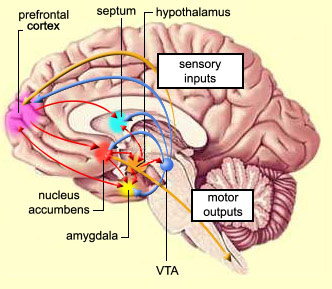
The brain’s reward circuit are located along the medial forebrain bundle (MFB). The ventral tegmental area (VTA) and the nucleus accumbens are the two major centres in this circuit, but it also includes several others, such as the septum, the amygdala, the prefrontal cortex, and certain parts of the thalamus. All of these centres are interconnected and innervate the hypothalamus (red arrows), informing it of the presence of rewards.

1. Love and addiction areas. The vasopressin and oxytocin receptors were equally distributed in the brains of male and female voles, according to Dr. Young, coupled with the close proximity of the nucleus accumbens and ventral pallidum - two regions with heavily interconnected structures - suggest that a common neural circuit in male and female voles regulates pair bond formation. The dopamine system of the nucleus accumbens produces the rewarding and sometimes addictive effects of sex, food and drugs of abuse. The receptors are closely located to the nerve fibers that release oxytocin and vasopressin.

Using fMRI to view the brains of easily orgasmic women as they climaxed, either with visual stimuli or by self-stimulation, Whipple found that the body's pain-killing center in the midbrain is activated during peak arousal. Signals from this part of the brain instruct the body to release endorphins and corticosteroids, and is also coupled to anxiety.

2. Feel good, feel bad. The pleasure system includes the septal area and part of the almond-shaped amygdala; the other half of the amygdala, the hippocampus, the thalamus, and the tegmentum (in the midbrain) constitute the punishment system (rage, anxiety, pain). The flip side of joy is pain. Whenever a mental patient flew into a violent rage or turned into a catatonic zombie, the EEG was almost certain to display the telltale sawtooth pattern. If the patient got well, the spike disappeared. ...

3. Schizophrenia. "The primary symptom of schizophrenia isn't hallucinations or delusions," says Heath. "It's a defect in the pleasure response. Schizophrenics (negative symptoms?) have a predominance of painful emotions. They function in an almost continuous state of fear or rage, fight or flight, because they don't have the pleasure to neutralize it." ... It turned out that electrical stimulation of the pleasure center automatically turned off the punishment system. The cerebellum, Heath learned, is a better entryway to the brain's emotional circuitry. Stimulating a precise half-inch of its cauliflowerlike surface automatically fires the pleasure area and inhibits the rage centers.

[From a patient story:] "There -- see the big delta wave appearing in the septal region. Sure enough, large, languorous waves are now coming from the lead to the septal electrode. There's almost an exact correlation. When he gets a rush of good feeling, the record shows large-amplitude waves in the pleasure system."" ...

Along with depth electrodes, Heath's team would often surgically implant a sort of tube, a canula, through which they could deliver precise amounts of a chemical directly into the brain. Oriental sacred texts (and Aldous Huxley's Brave New World) mention a legendary bliss drug called "soma", the food of the Himalayan gods. The real life version might be acetylcholine. When acetylcholine was injected into a patient's septal area, "vigorous activity" showed up on the septal EEG, and the patient usually reported intense pleasure - including multiple sexual orgasms lasting as long as thirty minutes. An ominous-looking scrawl on the EEG looks almost like the spoke-and-dome pattern of epileptic seizure. It's a very explosive activity. (Afrodisiaca is often acetylcholinic).

4. Psychosis. Nucleus accumbens is the key structure of the brain responsible for reward, motivation and addiction. Addiction, motivation and impulsivity has much in common, also learning. Amphetamine-like drugs (which increase dopamine levels by blocking its re-uptake) are the main drug treatment for Attention Deficit/Hyperactivity disorder of which impulsivity is a component.

Psychosis refers to a subset of the symptoms associated with schizophrenia - symptoms which include hallucinations and delusional thoughts. It is rather striking that although there is no cure for all of the symptoms of schizophrenia, there is a single pharmacological treatment for the psychotic symptoms - blockade of dopamine receptors. Nobody knows why an excess of dopamine might lead to delusional thoughts or hallucinations, but it seems rather remarkable that the control of a single type of molecule in the brain is capable of influencing a person's thought processes in such a selective fashion.

Dopamine is a neuromodulator released by dopaminergic cells that originate in the midbrain (Ventral Tegmental Area (VTA) and Substantia Nigra) and which project to a number of brain regions including the Prefrontal Cortex (PFC), the amygdala, the hippocampus and the striatum (Caudate nucleus). All of these brain regions have been implicated in schizophrenia, although perhaps the most interesting region of all is the nucleus accumbens. The nucleus accumbens is connected to all of these other important regions, and is known to contain a large proportion of D2 receptors. The importance of the D2 receptor in particular is suggested by the striking correlation between the ability of an antipsychotic drug to block this receptor and the ability of that drug to mitigate the symptoms of psychosis. What does the nucleus accumbens do in the brain? What does the D2 receptor do? When and why is dopamine released? What is the functional role of dopamine?

5. Migraine and epilepsy. In certain syndromes the two conditions epilepsy and migraine are associated, characterized by visual symptoms followed by a partial seizure and postictal migraine. The EEG reveals occipital spikes (visual?). The visual symptoms are often followed by seizures. After the seizure, approximately 25–40% of the patients develop migrainelike headaches with a migrainous aura.

Another epilepsy-syndrome is characterized by unilateral somatosensory or motor seizures and centrotemporal spikes. Clinical and electrographic features can shift from side to side. Speech arrest, pooling of saliva, and usually preservation of consciousness are also typical, although spread and generalization do occur. Epileptic seizures are predominantly multi-coloured with circular or spherical patterns as opposed to the predominantly black and white linear patterns of migraine. Also those of epileptic patients are predominantly centrally localized, whereas those of migraine patients are predominantly peripherally localized.

Attention-deficit hyperactivity disorder (ADHD) is also much more common in epileptics (20%) as compared to normal children (3-7%). Several mechanisms may account for the high prevalence, such as a common genetic propensity, noradrenergic system dysregulation, subclinical epileptiform discharges, or even seizures, antiepileptic drug effects. Children with attention-deficit hyperactivity disorder have a higher than normal rate of EEG abnormalities. The noise or the input level is much higher, and so the attention fades. Also memory can be halted.

The clinical diagnosis of visual seizures is easy if individual elements of duration, colour, shape, size, location, movement, speed of development and progress are identified. They are markedly different from visual aura of migraine, although they often trigger migrainous headache, probably by activating trigemino vascular or brain stem mechanisms.

6. Pain on/off. The trigeminothalamic tract and periaqueductal grey (PAG). Also indicates that the thalamocortical tract is an important component of migraine pathophysiology. The central sensitization observed in migraineurs is most probably related to an abnormal activity of the trigeminal sensory pathway. A possible dysfunction of the periaqueductal grey in migraineurs without aura, which could result in a lowering of the threshold for initiation of migraine attack through a lack of inhibition of the trigeminal sensory activation.

As a critical pain neuromodulating structure, the periaqueductal grey matter has been implicated with the activation of the nervous system in migraine. The ventrolateral periaqueductal grey is part of a descending paininhibiting system from the hypothalamus and frontal cortex projecting to the medullary and spinal dorsal horns. Periaqueductal grey matter activation inhibits contralateral trigeminovascular nociception. PAG was hyperactive during migraine. The exact neurotransmitters behind the aura are unknown, ev. NO. PAG is also involved in narcotic abuse.

The PAG has a large influence on the nociceptive pathways (pain treshold)(perception of pain = treshold value for pain) with extensive networks from thalamus, hypothalamus and autonomic nervous system. It is full of opiate receptors (endorphins and others) according to Pert, and is a control area for pain, and also for most of other peptides/receptors. Pain is a highly complex and with subjective experience that is not linearly related to the nociceptive input. It is well known that pain perception for patients and normal subjects can be modulated by psychological factors, such as attention, stress, and arousal. Activation in the periaqueductal gray was significantly increased when pain was inhibited. In many sensory modalities, afferent processing is dynamically modulated by attention and this modulation produces altered sensory experiences.
An increase in flow of the middle meningeal artery (MMA) also occured. Pert says that pain can be altered by expectanses, faith and it can even be altered into pleasure. What is the role of consciousness in this, asks Pert.

Trigeminus input to the brain has also a profound impact on the consciousness level according to Damasio. Pain is a conscious experience, an interpretation of the nociceptive input influenced by memories, emotional, pathological, genetic, and cognitive factors. Is consciousness dependent on perception (of pain = disturbance or noise?)? Or attention? PAG is also our first body map in the nervous system. And pain and serotonin is dependent on each other. Paininhibition means serotonin excreation with urine. Adrenaline and noradrenaline is the counterpart. Noradrenaline is happiness, says Pert. Is our consciousness dependent on a disturbance, or arousal? Sounds a simple question, but it isn't. These painmodulations can be initiated reflexively or by contextual manipulations of the pain experience including cognitive and emotional factors. This provides a necessary survival function since it allows the pain experience to be altered according to the situation. Plasticity, sensitization and other amplification processes might occur along the pain neuraxis for an individual and one can relate this to their specific pain experience or measure of pain. Individuals can gain voluntary control over activation in a specific brain region given appropriate training (biofeedback as ex.), that voluntary control (over behavior and cognition) over activation in the rostral anterior cingulate cortex (rACC), leads to control over pain perception, and that these effects are powerful enough to impact severe, chronic clinical pain. Pert also points out that breeding is a control of pain. Forced breeding make more peptides and of a different kind in the brain stem. They are then expressed in PAG.

7. Gender, developement, morphology, cognition and mood; the Dentate gyrus in hippocampus. In the late 1980s, the finding that the dentate gyrus contains more granule cells in the male than in the female of certain mouse strains provided the first indication that the dentate gyrus is a significant target for the effects of sex steroids during development. Gonadal hormones also play a crucial role in shaping the function and morphology of the adult brain. Besides reproduction-related processes, sex steroids participate in higher brain operations such as cognition and mood, in which the hippocampus is a critical mediator. Sex steroids modulate the function of dentate neurons under normal conditions. In addition, recent research suggests that hormone-induced cellular plasticity may play a larger role than previously thought, particularly in the dentate gyrus. Specifically, the regulation of dentate gyrus neurogenesis and synaptic remodeling by sex steroids, and gonadal hormones have neuroprotective potential. Gonadal hormones could also influence the dentate gyrus indirectly, by subcortical hormone-sensitive structures such as the cholinergic septohippocampal pleasure system.

Serotonin has also been linked to the effect of estradiol on dentate neurogenesis. Indeed, several studies indicate that estrogen influences the dentate serotonergic system, f.ex. estradiol treatment reduces serotonin gene expression in the dentate gyrus. That's perhaps the reason why menopause has been linked to kundalini-experience.

8. The secondary sexual behavior is also related to the anterior cingulate gyrus (in the roof of the limbic area), as a response of vasopressin and oxytocin receptors. Care for the offspring belongs here, as well as aggressive behavior (male). Large bilateral leisons abolish voluntary movement, but not awareness. "Nothing matters", and "I had nothing to say", said a patient. Smaller leisons gave severe depression and anxiety. Or loss of voluntary control of a hand (alien-hand syndrome), that has a will of its own. (Brain-wise by Churchland).


Selfcontrol over sexual arousal belongs here. Limbic areas can be controlled by free will. Autistic people have disturbances in cingulate gyrus (small cells, high density), hypothalamus, amygdala, mammillary bodies and cerebellum.

Motivation and decision-making belongs here too, orchestrated by serotonin and dopamine, norepinephrine and acetylcholine, as well as various hormones, estrogen and testosterone. Judgement and impulse control can fail due to too much estrogen or testosterone.

Control by suppressing emotions, feelings and inclinations is often believed to be rational (and virtue). But reason can never be a motive, or make decisions. Reason can't make free will, can't give aversion against something or a drawing to something. Reason can tell lies, storytellings and fantasies. Feelings is against or for, a common sense. Emotions is a good thing, but too much emotions and too much reason, virtue and moral can be fatal. As a rule strong passion can't be controlled, too much reason and you go astray.

9. The pineal gland is unique in its solitary status within the brain. All other brain sites are paired, meaning that they have left and right counterparts; for example, there are left and right frontal lobes and left and right temporal lobes. As the only unpaired organ deep within the brain, the pineal gland remained an anatomical curiosity.
The pineal gland of evolutionarily older animals, such as lizards and amphibians, is also called the "third" eye. Just like the two seeing eyes, the third eye possesses a lens, cornea, and retina. It is light-sensitive and helps regulate body temperature and skin coloration—two basic survival functions intimately related to environmental light (and emotions).

What have transcerebral, weak (1 microT) complex magnetic fields and mystical experiences in common? Are they generated by field-induced dimethyltryptamine (DMT) release from the pineal organ? Structurally, DMT is analogous to the neurotransmitter serotonin and other psychedelic tryptamines. Some believe it plays a role in mediating the visual effects of natural dreaming, and also near-death experiences, religious visions and other mystical states. In addition to being involved in altered states of consciousness, endogenous DMT may be involved in the creation of normal waking states of consciousness. Dimethyltryptamine dose dependently elevated blood pressure (tonus), heart rate, pupil diameter, and rectal temperature, in addition to elevating blood concentrations of beta-endorphin, corticotropin, cortisol, and prolactin. Growth hormone blood levels rose equally in response to all doses of DMT, and melatonin levels were unaffected. DMT and other endogenous hallucinogens mediate their neurological abilities by acting as neurotransmitters at a sub class of the trace amine receptors?

Decreased sensitivity to the serotonergic hallucinogens psilocybin and LSD is induced by drugs with effects on serotonergic neurotransmission, allopurinol and fluoxetine?

Hallucinogens' effects in humans are mediated by serotonergic receptors?In this way waking consciousness can be thought of as a controlled psychedelic experience, or stress induced by environment and giving rise to muscle work? It is when the control of these systems becomes loosened and their behavior no longer correlates with the external world that the altered states arise. A theory was also that a massive release of DMT from the pineal gland prior to death or near death was the cause of the near death experience (NDE) phenomenon. Several test subjects reported NDE-like audio or visual hallucinations. The explanation for this experience was the possible lack of panic/pain.

Attention and concentration is also an effect of serotonin, as well as violence and suicide can be that. In fact serotonin is very central to our human being charachters. This is something I have called "the serotonine wheel" for my own purposes. Are there also a "dopamine wheel", an endorphine wheel" etc.?

One of the most obvious physiologic manifestations of seasonality is the phenomenon of seasonal breeding. The pineal gland hormone, melatonin,mediates the antireproductive effects of decreased light exposure during winter months. Annual rhythms in humans have also been established, including, for example, seasonal variations in suicides, general mortality, a need for electroconvulsive therapy and the incidence of episodes of depression and mania. Melatonin is made from serotonin.

Pineal gland is very sensitive to magnetism. How is it with normal visual perception and magnetism? Pineal gland can easily be calcified with "brain sand" (fluor) and so can be hypofunctional.

Was Descartes right after all?
We shall continue with the God-concept. See also http://zone-reflex.blogspot.com/2009/07/chakras-and-colors-i.html

References
See also links.
Dynamical Theory and Novel 4D Colorimetric Method Reveal the Essential Modus Operandi of the Intact Living Brain--Study shows how areas in the brain integrate and segregate at the same time. Newswise. See also Tognoli, E., Kelso, J.A.S., Brain coordination dynamics: True and false faces of phase synchrony and metastability. Prog. Neurobiol. (2008), doi:10.1016/j.pneurobio.2008.09.014

Sheena K Aurora. Pathophysiology of Migraine. NeuroScience 2007 - Supplement to EU/US Neurological Disease 2007 Issue 1 (BTG). http://www.touchneurology.com/files/article_pdfs/neuro_7463

Knight Y.E., Goadsby P.J. The periaqueductal grey matter modulates trigeminovascular input: a role in migraine? Neuroscience, Volume 106, Number 4, 31 October 2001, 793-800(8).

Afridi and Goadsby. New onset migraine with a brain stem cavernous angioma
J Neurol Neurosurg Psychiatry.2003; 74: 680-681 http://brain.oxfordjournals.org/cgi/content/abstract/125/6/1392 - The selective low efficacy adenosine A1 receptor agonist, GR190178 (30–1000 µg/kg i.v.), also inhibited SSS-evoked neuronal activity in a dose-dependent fashion. In this model of trigeminovascular nociception, adenosine A1 receptor activation leads to neuronal inhibition without concomitant vasoconstriction,

C P Panayiotopoulos: Elementary visual hallucinations in migraine and epilepsy. J Neurol Neurosurg Psychiatry. 1994 November; 57(11): 1371–1374. http://www.pubmedcentral.nih.gov/articlerender.fcgi?artid=1073189

Michael A. Rogawski 2008: Common Pathophysiologic Mechanisms in Migraine and Epilepsy. Arch Neurol. 2008;65(6):709-714. http://archneur.ama-assn.org/cgi/content/abstract/65/6/709

http://www.ncbi.nlm.nih.gov/pubmed/18603235?ordinalpos=1&itool=EntrezSystem2.PEntrez.Pubmed.Pubmed_ResultsPanel.Pubmed_DiscoveryPanel.Pubmed_Discovery_RA&linkpos=5&log$=relatedreviews&logdbfrom=pubmed

Tibor Hajszan, Teresa A Milner,and Csaba Leranth, Sex Steroids and the Dentate Gyrus. Prog Brain Res. 2007; 163C: 399–816. http://www.pubmedcentral.nih.gov/articlerender.fcgi?artid=1964752.

Sculthorpe L, Persinger MA. Does phase-modulation of applied 40-Hz transcerebral magnetic fields affect subjective experiences and hypnotic induction? http://www.ncbi.nlm.nih.gov/pubmed/15002842?dopt=Abstract

Patricia Smith Churchland, 2002: Brain-Wise: Studies in Neurophilosophy. Cambridge. MIT Press.

lördag 1 augusti 2009

The Wickman thing

I just met a "brandnew" cousin, 54 years old. Just one year older than me. I have met her once before, in the sixties, when I was 6-7 years old. I remember that just vaguely. The Wickman family has many relatives "over there". In fact half the family? Some went long ago, and their children and grand children is now looking back, trying to find their roots. Monica too had her daughter with her. She was in the same age as my son.

Mostly Monica has just been a name on a paper, just as all the other cousins I have "over there". Monica. I remember I have heard my mam and dad speak of her and her three brothers too. She has lost contact with one of her brothers, the other ones she hardly ever meet.


Monica lived her childhood i Vesterås in Sweden. Her daddy was my uncle. I don't remember him at all, although I must have met him as a child. Her daddy was a person who moved a lot. He didn't think long for a decision, he just did it. He was quite stubborn too. (Guess from where I have got that one?) Nobody could tell him what to do. Monica told stories about my relatives and made them more living to me. And so I got to learn something about myself too, perhaps not so good things, but things I have wondered about. Why do I react at things that happens in the way I do? My ability to make fast decisions sometimes. You may ponder long, then something happens, and suddenly you just know. And you have to follow your idea.

Her daddy was fast to make decisions. She told when she was thirteen and her brother was 9, her dad took them from home to Whiterocks in British Columbia, quite a bit, in fact as almost half the Finland, and he liked the place, so he decided that they should live there. He rented a room and left Monica and her brother there alone. He himself went home packing. He took his wife and two other sons with him to Whiterocks. Fortunately they also was pleased with their new homes. Monica said "But what, if he had an accident on his way home? Nobody else knew where we were". That was Gustav, my uncle. I know it too well. Quess how many stories my parents have told me about my childhood and my ability to always make stupid things. It was my speciality. Monica said it was "the Wickman thing. All Wickmen do stupid things, but they are also very brave and do hard work. But so hopelessly stubborn!"

But it came to a divorce after a few years for my uncle.

Her daddy never told where he should go, or how long he would stay. Monica told me that for some reasons:-) she was quite the same. There were many stories of that kind that evening. Of course without reason:-) They never made such things it you asked them. No, no, no. Never.

And I am also like that. Quess why?
Only afterwards I can laugh. I laugh a lot.