måndag 22 februari 2010

Matter waves


Evolution of the interference contrast with changing heating intensity

Anton Zeilinger (Austria), Alain Aspect (France) and John Clauser (USA) received the Wolf-Prize in physics 2010. The three physicists share this high decoration for elementary conceptual and experimental contributions in quantum physics, especially quantum entanglement that represents the foundations for numerous modern quantum information technologies, such as quantum communication and encryption, quantum teleportation and quantum calculation. The Wolf-Prize is considered as one of the most reputable science awards worldwide. The price will be awarded through the President of Israel in Jerusalem in May 2010.


Anton Zeilinger, Institut für Quantenoptik und Quanteninformation Österreichische Akademie der Wissenschaften.

And yet there are still a lot of scientists that say matter has no wave-charachter, no duality. Quantum behavior is generally not observed in macroscopic systems. One reason is that an extremely high experimental resolution would be required to observe quantum phenomena, larger than can be practically achieved. But it can be done.

Lubos Motl has very big difficulties with this aspect of matter. He has difficulties with the finiteness in quantum physics too, getting inumerous different 'worlds'. Quantum entanglement is a unique feature of the quantum world and its essence. It is not seen in matter, says he.

Anton Zeilinger, a/the top experimenter in this entanglement field, surely agrees with everything I say, even with inconvenient things such as the statement that his experiment wasn't "really" new relatively to previous experiments and it was only new in its optimization to exclude nonlocal realism.
What the entanglement shows is that spatially separated systems can be found in states that are correlated with each other. But that was true even in classical physics, and it can result and usually does result from local physics.


Lubos say: If you send your pair of shoes by 2 trains, it's clear that one of the destinations A,B will receive a left shoe and the other will get a right shoe, even though it can't be uncertain at the beginning which is which. But no signals were spreading from the train station A where they saw a left shoe to the other train station B. Instead, the correlation was caused by the common past of both events - by your putting the 2 distinct shoes in the trains. The logic concerning the reasons of the correlations is just like in classical physics - the correlation is caused by a shared past, not by any "fast" influences at the moment of the measurement that would be needed to "enforce" the correlation. Consequently, no information can spread by these non-existent superluminal signals, not even in principle.


So, how can this price then be given for matter waves? And how can quantum computers ever be made? If the future computer is supposed to reach the stage of wide commercial application, it should be based on solid states systems.


Zeilinger: Our group pioneered the realization of novel quantum states and quantum phenomena with entangled photons, such as polarization entanglement, orbital angular momentum entanglement, Greenberger-Horn-Zeilinger (GHZ) entanglement, Cluster state entanglement, and other types of multi-particle entanglement, that are designed to demonstrate the unique and counterintuitive phenomena of quantum physics. We are also working on implementing quantum entanglement for new quantum information applications. Our group’s accomplishments include a number of applications of entanglement-based quantum information protocols such as quantum state teleportation, quantum dense coding, and entangled -photon quantum cryptography. One important aspect for future quantum communication networks, the ability to distribute entanglement over long distances, is addressed by our experiments on the distribution of entangled photons via optical fibres and via free space, and in the future, even using quantum communication satellites in Space

Entangled quantum states are not separable, regardless of the spatial separation of their components. This is a manifestation of an aspect of quantum mechanics known as quantum nonlocality. An important consequence of this is that the measurement of the state of one particle in a two-particle entangled state defines the state of the second particle instantaneously, whereas neither particle possesses its own well-defined state before the measurement.
.

Seems that they are of very different meanings. Zeilinger: It is commonly believed that for the understanding of the behaviour of large, macroscopic, objects there is no need to invoke any genuine quantum entanglement - Einstein's ”spooky action at a distance”. This is because decoherence effects arising from many particles interaction with the environment would destroy all quantum correlations. Our research, however, shows that this belief is fundamentally mistaken and that entanglement is crucial to correctly describe some macroscopic properties of solids.


The wave nature of biomolecules
We demonstrate quantum interference for tetraphenylporphyrin, the first biomolecule exhibiting wave nature, and for the fluorofullerene C60F48, says Hackermüller et al 2003. The porphyrins, which have low symmetry and abundant occurence in organic systems, have the theoretically expected maximal interference contrast and its expected dependence on the de Broglie wavelength. Since Louis de Broglie's hypothesis that all massive particles should also show wave behavior many exciting experiments have studied interference of electrons, neutrons, atoms and molecules. Our goal is to further explore the limits of quantum mechanics with even larger objects which consist of many strongly bound atoms, investigated at high temperatures.


But this is interference from the quantumphysics, seen as waves (de Broglie). It is an effect of quantum physics on particles.


Interference fringes of porphyrin.

The most elementary system carries one bit of information, a yes or no.
Since the total information carried by the system is not enough to determine the results of all possible measurements, these results must contain an element of irreducible randomness. Furthermore, the finiteness of the total information implies the existence of complementary observables in which an increase in the knowledge of one of the observables is at the expense of the corresponding decrease of the knowledge in other(s). We also derived the Malus law – the well-known cosine law for quantum probabilities – from the assumption of the invariance of the total information under the choice of a complete set of mutually complementary propositions.

Finally, quantum entanglement is shown to arise from the possibility that the information in a composite system may reside more in the correlations between elementary systems than in the individual elementary systems themselves
.

Although entanglement on its own cannot be used for communication, it surprisingly can produce effects as if information had been transferred: entanglement can save on classical communication. Entangled states are useful only to the extent that they exhibit nonlocal correlations. More precisely, we demonstrated that for every Bell's inequality - including even those which are not known yet - there always exists a communication complexity problem, entanglement between qubits, qutrits and higher dimensional states.


Entanglement can help separated individuals in making decisions if their goal is to find each other even in the lack of any communication between them. The efficiency of every classical solution for our problem has to obey, and demonstrate its violation by the quantum efficiency. This proves that no classical strategy can be more efficient than the quantum one.

A spiritistic world-wiev. Trust and faith? This means that the law of cause and consequence not always is true, if two systems are more correlated than one. But we already knew that.


And macroscopically
We demonstrated that macroscopic thermodynamical properties, such as internal energy, heat capacity or magnetic susceptibility - can reveal the existence of entanglement within solids in the thermodynamical limit even at moderately high temperatures. We found the critical values of physical parameters (e.g. the high-temperature limit and the maximal strength of magnetic field) below which entanglement exists in solids.

We investigated entanglement between two or more macroscopic samples - such as blocks of harmonic oscillators in a linear harmonic chain or sets of spins in a long spin chain - which can be revealed by measuring only collective observables of the oscillators or spins, respectively. In the case of oscillators we found that such entanglement can be demonstrated even in the cases when neither of the oscillators from one block is entangled with the oscillator from the other block (i.e. it cannot be understood as a cumulative effect of entanglement between pairs of oscillators.)

An entangled quantum system is impossible to describe by the states of its (local) constituents alone. Manifested in a phenomenon known as quantum nonlocality.

Oh, what a world. It is really so that All is One, as Cleopatra once said?

Macroscopic Thermodynamical Witnesses of Quantum Entanglement
Macroscopic thermodynamical properties - such as functions of internal energy and magnetization - can detect quantum entanglement in solids at nonzero temperatures in the thermodynamical limit. In the thermodynamical limit (where the number N of spins tends to infinity) entanglement was predominately investigated for the systems in their ground states.

Decoherence—the processes that limit the appearance of quantum effects and turn them into classical phenomena. One important cause of decoherence is the interaction of a quantum system with its environment, which ‘entangles’ the two and distributes the quantum coherence over so many degrees of freedom as to render it unobservable. Decoherence theory has been complemented by experiments using matter waves coupled to external photons or molecules. Large molecules are particularly suitable for the investigation of the quantum–classical transition because they can store much energy in numerous internal degrees of freedom; the internal energy can be converted into thermal radiation and thus induce decoherence.

Magnetic fields give the coherence?
According to our analysis, no violation of local realism is possible unless the RFs correspond to magnetic fields at least of order 104 G. This is much larger than can generally be found in nature (but still not impossible to produce).

Typically, quantum coherence in a system is quickly lost due to its interaction with the environment, but the coherence is preserved in correlations between the system and the environment. What is this? A window-effect?

The vibrational energy of atoms and molecules is another concept, giving rise to resonance. Our world is built on discrete particles that are bound in finite systems of discontinuous energies seen in finite number of wavelengths, respectively, colors that an atom emits.
Quantum wave effects allow tunneling through an energy barrier which would classically be insurmountable.
Also the creation of a polarizationentangled pair of red photons when a single UV pump photon interacts with a nonlinear crystal, or a measurement of both photons shows perfectly anticorrelated polarizations although the result on each side individually appears to be absolutely random.


Despite considerable research efforts the relation between the quantum entanglement and non-locality is largely unexplored. Among the open questions is: Which quantum states of composite systems are entangled and which of those are non-local? Understanding this relation is not only of importance for fundamental research, but also in the context of quantum information processing. For certain tasks, such as quantum communication complexity problems, distillation of entanglement or device-independent quantum key distribution, entangled states are useful only to the extent that they exhibit nonlocal correlations.

It is known that all pure bipartite entangled states violate the Bell inequalities. For mixed states, however, the relation between entanglement and non-locality is much subtler. We found that for three or more particles even the relation between pure entanglement and locality becomes subtle. We constructed a family of multipartite pure entangled states, which satisfy all Bell’s inequalities with two measurement settings per observer. All these strongly suggest that entanglement and non-locality are different concepts.

The Borromean Rings, the trinity.
Efimov predicted that resonantly interacting particles can form weakly bound trimer states, Efimov resonances. Efimov predicted that three quantum particles subjected to a resonant pair-wise interaction can join into an infinite number of loosely bound states, even if each pair of particles cannot bind. The properties of these aggregates, such as the peculiar geometric scaling of their energy spectrum, are universal, that is, independent of the microscopic details of their components.

Efimov focused his attention on the situation of three identical bosons with resonant two-body interactions. The resonant two-body interaction condition also greatly simplifies the physics of the three-body problem. It becomes universal in the sense that details of the short-range interaction become irrelevant except for an additional quantity, the so-called three-body parameter. The problem is then fully characterized by just two parameters, no matter whether nucleons, atoms, or other resonantly interacting particles are considered—Efimov was studying a very general phenomenon.

Molecular Borromean rings are an example of a mechanically-interlocked molecular architecture in which three macrocycles are interlocked in such a way that breaking any macrocycle allows the others to disassociate. They are the smallest examples of Borromean rings, and is only possible because the building blocks self-assemble. The synthesis of molecular Borromean rings was reported in 2004 by the group of J. Fraser Stoddart.


The preparation of the tri-ring Borromeate involves a total of 18 precursor molecules and is only possible because the building blocks self-assemble through 12 aromatic pi-pi interactions and 30 zinc to nitrogen dative bonds. Because of these interactions, the Borromeate is thermodynamically the most stable reaction product out of potentially many others. As a consequence of all the reactions taking place being equilibria, the Borromeate is the predominant reaction product. From wikipedia.

The Borromean rings have been used in different contexts to indicate strength in unity, e.g. in religion or art. In particular, some have used the design to symbolize the Trinity. They are formed by braiding, knotting etc. too.

In biology this is realized as chaos giving order? The Prigogine triangular effect.

Even chaos is in QM. Chaotic behavior is the rule, not the exception, in the world we experience through our senses, the world governed by the laws of classical physics. Even tiny, easily overlooked events can completely change the behavior of a complex system, to the point where there is no apparent order to most natural systems we deal with in everyday life.

Until now, no one has produced experimental evidence that chaos occurs in the quantum world, the world of photons, atoms, molecules and their building blocks. "The problem is that people don't see [classical] chaos in quantum systems," said Poul Jessen. "And we believe quantum mechanics is the fundamental theory, the theory that describes everything, and that we should be able to understand how classical physics follows as a limiting case of quantum physics." Jessen's experiment revealed a new signature of chaos for the first time. It is related to the uniquely quantum mechanical property known as "entanglement." Theorists have speculated that the onset of chaos will greatly increase the degree to which different parts of a quantum system become entangled. this concept of entanglement has tendrils in all sorts of areas of quantum physics because entanglement is actually common as soon as the system gets complicated enough.

That was the opposite. Chaos and order, dissipation and negentropy.

And so something odd: In relation to this it is symptomatic that quantum formalism makes no difference between the description of two (space-like) separated particles and of two degrees of freedom of a single particle with a corresponding Hilbert space dimension. This suggests that spatial distance in the ordinary three-dimensional space is irrelevant in the abstract Hilbert space description of quantum mechanical systems. In our view this relativizes the violation of locality condition as a possible explanation of Bell’s theorem.

One can also have situations where someone knows more than everything. This is known as quantum ‘entanglement’, and when two people share entanglement, there can be negative information.

Making Quantum Behavior Observable Using Optical Levitation. That parapsychological problem of levitation? Teleportation too.

Researchers has taken the first steps toward showing how a pair of vibrating membranes can form a molecule-like state. By interacting with photons from a laser, the membranes become coupled together. In one mode, the membranes move together, while in the other mode, the membranes move opposite to each other. Since these vibrational states are analogous to the excitations of a single molecule, the experiment demonstrates how the two membranes act as a single system.

The results could enable physicists to investigate the transition from the quantum to classical world.

måndag 8 februari 2010

Spirals and magnetic fields

This is linked to my earlier story http://zone-reflex.blogspot.com/2010/01/spirals-very-small-and-very-big.html

Researchers create 'synthetic magnetic fields' for neutral atoms, an article in Phys.org last dec. An atom can be made to behave as a vortex. Very much in the same way as a soundwave do. You see all the spots. The laser beams, combined with an external magnetic field cause the atoms to "feel" a rotational force; the swirling atoms create vortices in the gas.


Top panel shows time sequence of (a.u., arbitrary units.) Bottom panel shows vortex number Nv (solid symbols) and atom number N (open symbols)from Nature art.

Researchers have created "synthetic" magnetic fields for ultracold gas atoms, in effect "tricking" neutral atoms into acting as if they are electrically charged particles subjected to a real magnetic field. These ultracold gases have become ideal laboratories for studying the complex behavior of material systems. Unlike usual crystalline materials, they are free of obfuscating properties, such as impurity atoms, that exist in normal solids and liquids. However, studying the effects of magnetic fields is problematic because the gases are made of neutral atoms and so do not respond to magnetic fields in the same way as charged particles do. The laser-illuminated neutral atoms react to the varying magnetic field in a way that is mathematically equivalent to the way a charged particle responds to a uniform magnetic field. The neutral atoms experience a force in a direction perpendicular to both their direction of motion and the direction of the magnetic field gradient in the trap. By fooling the atoms in this fashion, the researchers created vortices in which the atoms swirl in whirlpool-like motions in the gas clouds. The vortices are the "smoking gun," Spielman says, for the presence of synthetic magnetic fields.

At a one-vortex-per-atom ratio, they could observe the quantum Hall effect and control it in unprecedented ways. In turn, they hope to coax atoms to behave like a class of quasiparticles known as "non-abelian anyons," a required component of "topological quantum computing," in which anyons dancing in the gas would perform logical operations based on the laws of quantum mechanics.

So also the atom has spirals.

Quantum communication networks show great promise in becoming a highly secure communications system. By carrying information with photons or atoms, which are entangled so that the behavior of one affects the other, the network can easily detect any eavesdropper who tries to tap the system.

So, an atom can be entangled too. Entanglement is not only a quantum property, an uncertainty in a particle. Physicists working up from atoms to Schrodinger's cat. Schrodinger's cat, a macroscopic object that is both alive and dead at the same time, illustrates the strangeness of quantum mechanics. While such quantum properties have been widely observed for electrons and molecules, recent experiments have shown that larger objects may also demonstrate quantum effects. Just how large, though, is still an open question.

Molecules can begin to spiral when they react too.

'Tornadoes' are transferred from light to sodium atoms. Tornado-like rotational motions have been transferred from light to atoms in a controlled way at the National Institute of Standards and Technology. The new quantum physics technique can be used to manipulate Bose-Einstein condensates. As reported in the Oct. 27 2006 issue of Physical Review Letters, the research team transferred orbital angular momentum--essentially the same motion as air molecules in a tornado or a planet revolving around a star--from laser light to sodium atoms.

Physicists have finally managed to demonstrate quantum entanglement of spatially separated electrons in solid state circuitry. For the first time, physicists have convincingly demonstrated that physically separated particles in solid-state devices can be quantum-mechanically entangled. The experiment is reported in an upcoming issue of Physical Review Letters and highlighted with a Viewpoint in the January 11 issue of Physics.

Superposed quantum systems are correlated. And tripartite systems can behave quite surprisingly. A wedding cake is the result :)

Quantum phase transitions also show universal critical behaviors, which are affected not only by temperature but also by quantum mechanics. Also classical phase transitions…often share many fundamental characteristics near the critical point.

The phase transitions are the criticality key?

söndag 7 februari 2010

The singular I and the observer

An interesting discussion is going on in the different blogs. It is about our world-wiev with spirituality, about entropy, gravity, self, the observer-effect, time, holography etc. In short it is about reductionism or not. I thought I would never live to witness this turn-around, this paradigm-shift. It is here now, so start discussing all those basic things again. A new world-wiev is waiting.

Lubos Motl don't like this at all.

God is the creativity of the universe

Stuart Kauffman in BEYOND REDUCTIONISM, Reinventing The Sacred 2006, and he says: I would like to begin a discussion about the first glimmerings of a new scientific world view — beyond reductionism to emergence and radical creativity in the biosphere and human world. This emerging view finds a natural scientific place for value and ethics, and places us as co-creators of the enormous web of emerging complexity that is the evolving biosphere and human economics and culture. In this scientific world view, we can ask: Is it more astonishing that a God created all that exists in six days, or that the natural processes of the creative universe have yielded galaxies, chemistry, life, agency, meaning, value, consciousness, culture without a Creator. In my mind and heart, the overwhelming answer is that the truth as best we know it, that all arose with no Creator agent, all on its wondrous own, is so awesome and stunning that it is God enough for me and I hope much of humankind.

Thirty-five years ago, he developed the Kauffman models, which are random networks exhibiting a kind of self-organization that he terms "order for free." He asks a question that goes beyond those asked by other evolutionary theorists: if selection is operating all the time, how do we build a theory that combines self-organization (order for free) and selection? The answer lies in a "new" biology.

But this 'order for free' is coded information, stored entropy, or as we usually say, negentropy. Some kind of inherent memory. Not random at all.

Lubos say: entropy cannot be negative.


Outlaws in a creative universe? An open Universe? Lonely Gods sitting in their own Universes?

Kauffman says: If there is order for free — if you have complex systems with powerfully ordered properties — you have to ask a question that evolutionary theories have never asked: Granting that selection is operating all the time, how do we build a theory that combines self-organization of complex systems — that is, this order for free — and natural selection? There's no body of theory in science that does this. There's nothing in physics that does this, because there's no natural selection in physics — there's self organization. Biology hasn't done it, because although we have a theory of selection, we've never married it to ideas of self-organization. One thing we have to do is broaden evolutionary theory to describe what happens when selection acts on systems that already have robust self-organizing properties.

What is the difference between physical evolution and biological evolution? A brick stone like Darwin? An other way to ask the same thing is 'Is evolution unavoidable?' A force by its own? Not a result of any Selfish gene, as Richard Dawkins believe. What directed the world before there were any genes? The creativity of the Universe?

Reductionism, wrought by the successes of Galileo, Newton, Einstein, Planck, and Schrodinger, and all that has followed, preeminently in physics, has left us in world of fact — cold fact with no scientific place for value, says Kauffman. "The more we know of the cosmos, the more meaningless it appears", said Stephen Weinberg in Dreams of a Final Theory.

So meaning and value, ethics is the discussion? We are living in a meaningless world in our post modern world, seen in the area of politics. Money and personal gain is not enough. It give rise to disgust? Reason: lack of value.

Matti Bergström wrote about that long ago. Politicians are becoming politicians because they are value-poor and want to have also the values of other people, gained in elections. So the medicine is then to take our personal value back? perhaps that is what they are doing when people don't wote. Because it is meaningless. Politicians and doctors, 'the system' has taken too much value from the people, so the people themself are left with no meaning?

The result of that has always been revolution.

God is meaning and value, says the priests. But they are not convincing. Only by force, seen in fundamentalistic religions as Islam and 'Intelligent Design' in US. Also the Church(es) has taken too much value from the people.

Kauffman continues: We secular humanists have paid an unspoken price for our firm sense that (reductionist) science tells us what is real. Can science give us humanity?

The two cultures, science and humanities, remain firmly un-united. And equally important, we have been subtly robbed of our deep capacity for spiritualism. We have come to believe that spirituality is inherently co-localized with a belief in God, and that without such a belief, spirituality is inherently foolish, questionable, without foundation, wishful thinking, silly.
Well, now he is definitively up to something. I believe in 'God' but not in the God of church, but the God of Nature, or Universe. A fundamental law.

We lack a global ethic to constitute the transnational mythic value structure that can sustain the emerging global civilization. We tend to believe in the value of democracy and the free market. We are largely reduced to consumers, also in our personal education, even in our enjoyment of the wild, we are reduced to consumers. We need our myths, our value-history, our archetypes, said also Joseph Campbell in The power of Myth, and Carl Jung, who said that the archetypal world, our collective unconsciousness can change and demand revolution and war.

So the values are in our unconscious world. It is something that we have but we don't know of it. Matti Bergström said: The little child has only one thing; value. Take it away and it will die. The child needs love as a fundamental force. Love and hope are fundamental values?
The same in a marriage. The husband may be rich and his carrieer goes well, but his value is to a very large degree not depending on this, but his success to have a good family-life. Often the wife has a bigger value than the successful husband. This tells the value is a weak force? Money is a bad value. Humans need more, much more.

We are hard-wired for faith, said Candice Pert in 'Molecules of emotions'. She meant religion, but what is faith? Is it trust, company, a group-thinking, even althruism? (in fact we have a gene for althruism, that 'talks' when things go bad. Why not when things are good?

Roughly, reductionism is the view that, as Nobelist Stephen Weinberg eloquently puts it, the "explanatory arrows always point downward", from society to small groups to individuals to organs to cells to chemistry to physics and ultimately to something like Weinberg's 'Dreams of a Final Theory', a single set of laws, a TOE. In biology is said that 'the sums of the parts can never make úp the whole, because it is always more'. Is something emergent here? Needs the holistic wiev something emergent? As a God? Or can it be created?

Can a TOE also be a theory of God? Or is God always outside?

Kauffman says: The reduction requires the truth of the "ergodic hypothesis" and there is some evidence that it might be false. The physicists who hold out for a firm reductionism are, like Weinberg himself, largely high energy particle physicists, seeking that final theory — say string theory. Also biologists are said to very reductionistic. But is the reductionism unavoidable? Doubts are arising in the realm of string theory, he says. But at present, it appears that there are as many as 10 to the 500th power string theories. Hope for a single theory is fast fading and a number of high energy physicists are abandoning reductionism in the sense of finding such a single theory. No wonder, because they have missed the point, the collapsing, the criticality, the finiteness of reality. Every probality is not realized.

Muliverses are the solution, an attempt to explain the roughly 23 physical constants in physics like the speed of light, the ratio of electron to proton mass, and so on. No one knows where these constants come from or how to explain them. I must say that this alone means that the physics are far from done, that there is also new physics. Stringists add to the constants by adding an anthropic factor. An almost final theory of everything, saw I. Only those with constants that support the evolution of intelligent life would have such life to wonder at the values of the constants. Intelligence is the driving force? Sounds like Intelligent Design. By our earlier definition intelligence is far from value and ethics that are unconscious.

Kauffman: In its stead a new scientific world view is just starting to come into view: Emergence.
- complex systems are too complex to be explained by reductionistic practices
- new entities with their own properties and causal powers arise

The first sound ad hoc, in the second; what would arise? What part is such that could arise? The meaning? The value? But the value is inherent in a baby, in a money, in a vote? The value can be transfered. The value can be sold. The value can be given. The value is relative, like an entropic force. It can't be created?

In the bottom lies the problem of numbers. Are numbers real, are derivates of numbers real, are primes real? What is the foundation for math? Can a number be emergent? Yes, phi or PHI, pi are emergent. But what do they mean? Simply a cutoff? A border for different patterns, informations? Are there more cutoffs, more basic information? p-adics are, as used in TGD. But they are not emergent. Spacetime is not emergent in TGD. Erik Verlinde says it is.

References
http://motls.blogspot.com/2010/02/entropy-information-and-mixed-states.html#more
http://www.edge.org/3rd_culture/kauffman06/kauffman06_index.html
http://www.ibi.ucalgary.ca/people#Kauffman
http://www.npr.org/blogs/13.7/2009/12/breaking_the_galilean_spell_an.html
http://www.npr.org/blogs/13.7/2010/02/law_or_not_at_the_quantumclass.html
http://tgd.wippiespace.com/public_html/index.html TGD
http://www.math.columbia.edu/~woit/wordpress/?p=2714&cpage=1#comment-53059
http://arxiv.org/abs/1001.0785 Erik Verlinde

måndag 1 februari 2010

The Sun is singing

I must tell you more about the Music of the Spheres. Our Sun is singing to us. It is the solar wind :)


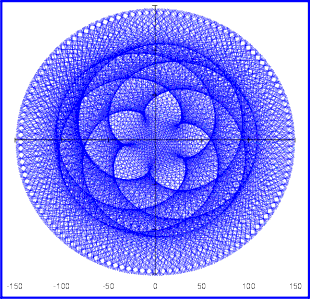
Venus/Earth-loops as seen from Venus over a period of 15.987 years. A view from Earth yields the same figure, only turned by 180 degrees. After about eight years we witness the full blossom of a fivefold starflower with Sun in the centre of the co-ordinate plane. Beautiful. Are they singing too?

I read a paper about it and I give just a link. Poincaré Hyperbolic Disk do not sound so good in my ears :) but behind the link is a fantastic story. First a computer image of the p-modes.


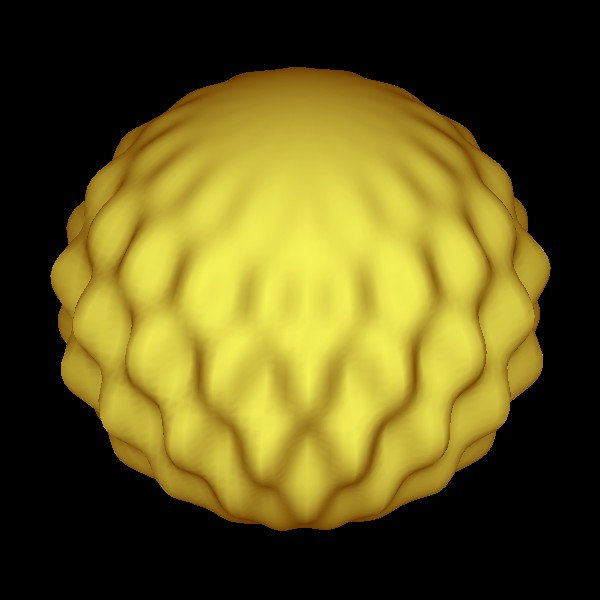
As the waves move outward they reflect off of the sun's surface (the photosphere) where the density and pressure decrease rapidly. Inward moving waves are refracted (their direction of motion bent) by the increase in the speed of sound as the temperature increases and eventually return to the surface. These trapped sound waves set the sun vibrating in millions of different patterns or modes (movie is found on NASA site). Since sound is produced by pressure, these modes of vibration are called p-modes. One mode of vibration is shown in the image above as a pattern of surface displacements exaggerated by over 1000 times.

The mysterious source of these oscillations was identified by way of theoretical arguments in 1970 and confirmed by observations in 1975. The oscillations we see on the surface are due to sound waves generated and trapped inside the sun. Sound waves are produced by pressure fluctuations in the turbulent convective motions of the sun's interior. As the waves move outward they reflect off of the sun's surface (the photosphere) where the density and pressure decrease rapidly..
A movie shows how this mode of oscillation consists of two oppositely moving waves. This from NASA.


The pattern of a p-mode solar acoustic oscillation both in the interior and on the surface of the sun, would give the music. SOHO gives images of the solar atmosphere at several wavelengths, and therefore, shows solar material at different temperatures, that gives pressure fluctuations and sound waves. Gravity waves too, if this entropy model of Verlinde is true. Nice.

Pythagoras, who – as the legend has it – could hear the “music of the spheres”, discovered that consonant musical intervals can be expressed in simple ratios of small integers. This concept was transferred by Platon (amongst others) into models about the structure of the universe common in the ancient world. And today this model is transferred into quantum physical models as seen in Nassim Haramein and the Resonans Project, or Peter Rowlands 'Zero to infinity'. Also behind the math in Tony Smiths homepage. The ancients meet our future. What a good thought. I love it.

Some thinks the metaphysics is trash, but I love it. I'm convinced that they knew something that we don't know today. But we are going for it. Maybe the direct way is not the right way? It is only analogies and metaphores, but with a truth in it.

Listen to the Sound of the Spheres.