söndag 4 december 2011

Kea's lost thread. My inquiry.

Mitchell Porters blog 'The Lost Thread, Notes from the work of Marni Sheppeard' from a deleted thread at PhysicsForums.com, is discussing Sheppeard’s work. I have some years been following her blog and her difficulties. Sometimes I have felt sorry for her, sometimes frustrated, sometimes even angry. Those feelings are mutual, I think. She is a very 'unorthodox' person with an equally unorthodox theory or hypothesis. She claims everything must be done from scratch, everything must be created again, due to errors and misinterpretations in the past. Mitchell Porter asked me to write about my view of Keas science here, because I am an amateur. He said he would comment here, not at the thread. That is the reason for this post. First the background. This is only from recorded communications, not personal. Maybe I must point it out.

I have many times tried to have her speaking, in vain. Guess I am a bit lazy. Also that my interpretations as a layman cannot be so exact.

On Galaxyzoo she said oct.1.11:
Ulla's arrogance is mind boggling. This needs to be noted, because she is misleading people about the physics. She doesn't know the first thing about mathematics, let alone physics, and she thinks she can tell me about physics just because she reads Matti's blog. Ulla, you don't understand one paragraph of any of my papers, and you shouldn't believe everything the Dudes say about women in physics. I am always, always wrong, and behind the times, and stupid, and so on and so on and so on. You let your neurotypical groupie brain cloud your judgement. If you really cared about the science, you would spend more time studying elementary physics.


Dark Matter was first studied around 80 years ago. All theoretical physicists have been thinking about it since then. Mirror dark matter is one of the oldest ideas, and it is most certainly not Matti's own. In Physics, the details matter. Airy fairy tales don't mean shit.

Oops! Whom is she talking of? Me? It is pathetic, I am shy. The kindest person on Earth? Have I the right to talk to HER, sitting in the physics heaven? This only because I asked about dark matter, and said it could not be only from neutrinos. I think I made it clear I am no expert, so I would not mislead anybody. And Matti dislike mirror-talk (technicolor). My comment leading to this outburst:
I have thought of what kind of signal light is. It is entropy. This entropy seems to come from annihilation, and some say neutrino can act as a Dirac point. Light speed is a property of space in vacuum, not a function of something that travels through it.. Light creates negentropy (noise) in form of em-waves, and takes itself the same form (oscillate as quanta), because it is the surroundings. Only in this surroundings c=1?. This follows the uncertainty too?
This em-force is just one force, but it creates the entanglement and the macroscopic tensions; microscopic tensions are made of gluons, and those make up most of our gravity. Gravity is 'long-term memory' of Universe, and hence also entanglement ("sensors")? Kea has the non-locality there? The entanglement must be there in order to have reactions.

http://arxiv.org/abs/1101.3357 It has long been known that photon bremsstrahlung can lift helicity suppressions, also from W and Z-bosons. it has been proposed the excess electrons and positrons are not due to conventional astrophysics process, but arise instead from dark matter annihilation or decay
http://arxiv.org/abs/1002.2441,2010 flavor sensitivity

Nice to see that Kea finally has realized the dark matter scenario. But solely leptonic DM cannot be the whole truth. The whole DM-hierarchy nust be involved, because DM is also ordinary matter [over 95% of all matter is baryonic, quarks], but invisible to us. It also has 4D? And she has the prime field/world there. Why must she and Matti Pitkänen be so dam stubborn so they cannot even talk to each other. Sic!

I KNOW I am long from any "expert" on this, but still I can have questions and opinions. I have followed Keas blog in many years now, with bigger and lesser interest. She is one of few who knows what she talks about, but it is so hard to follow without math skills.

On a question I added: There are no facts in this story. This view follow the astrophysical view, and also TGD. Kea is coming to it? It is wrong to think DM would be some WIMPs or other exotic particle solely.

Graham Dungworth supported me. With many words as usual.
Ulla's conclusion is that the whole DM hierarchy is involved and Kiske valid response is whether that means that DM as ordinary matter is fact.

Many on the forum are aware of the total energy composition of the universe when expressed as approximately 4.5% normal matter, 20.5% dark matter(DM)and ~75%dark energy(DE). It matters little whether there is presently 73% DE from say WMAP. It is essentially a book keeping exercise. As we go into the future, forget reference frames, as the universe ages and remorseless expansion ensues by the time that the system doubles in size, the matter density drops as the cube of the expansion size. Thus a doubling of size leads to an eight fold reduction of matter density. The DE fraction is generated at constant density so when the universe is 8 fold greater in volume the matter fraction , normal matter and DM matter will represent ca. 3% and DE ~97% of the total energy composition. When the universe was young DE caused by the expansion of space was negligeable, as it ages the DE/matter ratio increases. After another doubling of size that is model dependent upon the Hubble flow the time factor varies; it could be ca. 40 billion years before the current universe has doubled in size. Again, because distant supernova were reported to be dimmer than predicted it would appear that the universe is now accelerating its expansion and that doubling time is decreasing.

All we know of physics concerns that 4.5% fraction of normal or ordinary matter. Stars and ourselves are constructed from it; as atoms, the elements we know of. Let's not quibble about ionised states and plasmas. All these atoms are made from more fundemental particles; protons , neutrons and electrons that include the latter's lepton cousin the neutrino. At a deeper description, the protons are built from quarks, the u and d types you are familiar with. There are a total of three copies of normal matter and these include higher energy forms of these basic building blocks. The second incorporates strange and charmed quarks and these are associated with different leptons the muon rather than the electron electron, the former is much more massive ca. 206 fold than the electron mass. Basically, you buy the whole package and the hierarchy of normal matter according to the particle physicists incorporates forty two 42 of these particles and the force particles by which they interact. This is no joke. When Doug Adams realised the significance of the numerosity of this package, you may haggle whether it's 36 or otherwise, but for him it was the forever immortalised secret of the universe; the secret of that 4.5% matter mass fraction although he never lived to know what the composition was.

The physicists have to satiate a large number of conservation laws within the SM. It is inconceivable to think of a universe constructed of say photons only; or of electrons only. At the most basic level, when a proton changes or transforms to a neutron, in standard nuclear fusion or in a supernova explosion, electric charge conservation necessitates that a positron is formed but this violates lepton conservation number so another particle must exist to conserve what a chemist would call stoichiometric balance, and that particle is the uncharged lepton or neutrino. You might quibble and say the neutrino is not a building blockand plays no role in atoms. You are taught that electrons have attributes or charges. First there is the mass charge. Electrons also have rest mass and electric charge and that they "spin", one of the two types of angular momentum. Additionally, conservation laws crop up that require they have what is called a further spin type or weak isospin. I've discussed these niceties before.
What Ulla alludes to is the whole hierarchy. Hierarchy has is a religious meaning. It is a priestly word. You have to accept the creed as a whole. One cannot pick and choose. Most physicists might object about this useage. However, they are left with one conservation law called parity that they cannot ignore. As a consequence they accept that if parity is conserveed in this universe, and it blatantly is not, then there must be areas where forms of antimatter exist- very doubtful-or that parity is conserved elsewhere in a multiverse. They would never like to admit that our universe just happens to be cack handed. It could have been left or right handed, pure chance decided the route that was taken. Whether you are religious or not swallowing the whole creed is difficult. It's impossible to avoid and yet we are discussing a 4.5% component. What about the rest? Unfortunately, this forum doesn't have the terabytes available to pursue an exhaustive discussion and neither would the whole planet were it restructured as a giant processor of information.

Ulla from a biology background hits us with a great truth. She accepts the creed. There must be other parity stuff around but where. All that other kind we know of is DM. There are many candidates for DM, the fashionable WIMPS for instance, but these don't address the parity problem but do admit different mass charges in supersymmetry extensions to the SM (Standard Model). In nature species carry around various attributes that are continually used. They don't carry useless spare baggage that would reduce their chances of survival. By the time molecular evolution evolved they all agreed to adopt the left handed chiral stuff, at least here on Earth. But that may not be the case elsewhere. Kiske then asks " Is the implication that DM is ordinary matter". The answer is yes but it may have differing mass charges and opposite parity or mirror chirality.
The preliminary Minos results was staggering news for physicists. It implied new matter of a type they never imagined and a problem that would hopefully go away.
If there are new neutrino types they would have to buy a more complicated hierarchy or creed, new baryons, new hadrons etc. After all supersymm or SUSY is long on doubling the hierarchy, many accept that and many don't; there's a reformation of creed going on. DM is nonbaryonic. That's burnt into the memory cells of most readers. If the new neutrino types exist that doesn't mean that DM is soley neutrinos, it means that there is a full hierarchy present of another or other or allo form of normal matter. An amazing coincidence of these predicted masses revels that such matter annihilations would give rise to a background radiationin the universe that is happening now and is not some relic radiation from a past that had a beginning, a creation event; the first line of the creed. All religions have a creed, several lines worth. Marni, Ulla and myself may have some differences but we agree on much as we rewrite the first lines of the beginning of a creation. We are not writing a new creed or hierarchy for matter of all types. We are addressing only that first single line where we conceive of a cold dark , stark and pallid place that never had an origin , that just existed timelessly as an ensemble of photons and neutrinos that was on the move, of a universe we know of yet to be created.

I continued:
In that way the DM could basically be only leptonic, if quarks are made from leptons. Neutrons can interact, maybe also neutrinos, I don't know. Photons can, which maybe is an indication of the quark compositeness. This is maybe the color problem of the strong force? About this we know almost nothing yet. And what we know talk against this picture. Leptons and baryons are conserved separately? This make also the conservation laws questionable.

The neutrino problem is OUTSIDE GR and SR, so Einstein may rest in piece. We have only seen a glimpse of a bigger frame (of entanglement?) as Wilczek said. First we must see if the FTL result hold. There is physics of uncertainty that say it may hold. Remember, they have thought of this in many years now, and concluded it was most honest to publish it. Very few got afraid and withdrew their names.

Also On viXra blog and on her blog we have had disputes. I asked Matti about his view on his blog.

ThePeSla said... The algebra of the sub-manifolds is in the cracks of the limits of our total standard theories and in the low dimensions, as Kea points also also, there is a Pythagorean relation- for me the 6 inside that triality triangle thus 24 is the hidden subspaces tangled or not.

Only in planes we have of course enumeration in quadratic time so to speak. These of course are in the cracks also as such early simple ideas as 24 dimensional lattices. But the reverse compliments and need for so many zeros in the assumed one dimensionality of a p-adic number as if the decimal reversed (and for some reason the composites dismissed as if primes can casually be taken or added to or subtracted from some power of 2 the even one) is an essential idea that tends to shift the ground, that is becomes a wider universe and its forces.

Matti: To me this talk of Kea about 24-D lattices, magic matrices, and Koide mass formula does not give much. I am simply unable to comprehend what is the point and big picture. In politically incorrect mood I would call it numerology;-).

I have heard about the numerology also from others, comparing to Eddington. Is her work just numerology?

I said...Well, if you don't understand Kea, how would I then? I have the same feeling, that her cosmology fails. But she uses the same numbers, the same structure as everyone else, how can then her construction need another type of Universe? Also her claim that neutrinos, that are non-interactive, make up the interactive DM (which is invisible ordinary matter in the cosmology of today) seems odd. That would mean that leptons are building stones for fermions [should be baryons] (3-quarks), and that we think is wrong. Quarks have the triality seen in her figures, though, but when she use them for neutrinos????

And why cannot she explain this in a coarse manner? I really don't understand her. She spit out harsch text, but when she meets a simple question she gets silent. Her 24-figure inside the triangle is fascinating, but then she refers to Pythagoras!!!! Is she a nut? I am astonished. Kea, if you read this, start talking.

I would rather think that neutrinos are in the non-Euclidean space (= outside GR) with a very small interaction with matter (GR). How would that interaction be seen in space with all the cosmic rays? And how do they interact with light? Orwen raid they pull out light from vacuum, but how? Annihilation is the opposite process? Can neutrinos be made interactive through a change of spin?

Matrices tells nothing at all of these circumstances. Remember that Kea mostly talk of abstract (= virtual, DM) braidings, and there is reason to suspect she travels at deep water. There is the entanglement, some kind of pressure, or heat, as environment etc. Is there any real 'structure' at all to do all those matrices with? Or are there just a quantum field as a 'soup' of numbers. Environment? So in fact she plays God. I would want to know what she thinks about this. No fairy fields, but she works in the fairy field? I have asked her many times, but as long as I cannot answer these questions her figures are just curiosa. And she wonders why nobody uses her works?

ThePeSla said... Ulla, Ulla,
I do not understand what you have against Pythagoras (and for that matter Kea's take on things). No one uses Kea's advancing work because they simply do not get it.

I answered: I have absolutely nothing against Pythagoras. He was a genious. I reacted on Keas way to refer to him as some kind of great insight. As if she was not aware of what she was doing?

No one understand her work, so why doesn't she write about her wiev. I want her 'Higgs mechanism' even if she has no fairy fields she have something instead. I want her cosmology, when she says she will make everything new, just a drawing is enough. Her matrices are exactly what you say, but you forget she works on the negative side of reality, abstract geometry (I wonder how it looks like, because I doubt it can have any matrices). Antimatter is annihilated, so those matrices must be very otherwise. The only reasonable thing she can use the matrices for is DM, but she says it is not there. She claims leptons (neutrinos) make up the 3-quarks. I have not seen any model for how she makes the bridge between leptons and quarks (the triality is not enough). She talks of l-adic braids but cannot get the unification, although Matti has done it for p-adic hadrons. I suppose you can read what I wrote.

I have absolutely nothing against Keas as person, on the contrary I wanted to help her. She reacted negatively when I tried to have her make peace with Matti, after their controversy. She should have defended her ideas, that's how this world works. You cannot sit like a child and spit out ugly words when someone asks something, even if it is just a stupid biologist.

I have quarrelled at Matti too over this stupidity, so the situation is quit. It doesn't matter if Kea says she owns something. It is her statement and future will tell. If there are two controversial scientists so near each other as Kea and Matti, it is very idiotic they cannot talk to each other because of that small controversy.

Maybe I am impatient, but I have followed her so long, and I waited she would come up with something now when the superluminal neutrinos are actual, but instead she start everything all over again. More than anything I want to give her a kick :) to get further.

Zero positive or zero negative, what is that? What exactly is zero? What is a string in no dimension? Words, words...

Orwin: Kea swims in the New Wave of category theory, which is good at the analogies the Medievals loved. But that's proper to language/Logos, not Nous, and hence the Romance gender-typing.

The New Wave take on a kind of computational proceduralism, as if to upgrade MATLAB for AI. Matti's with the new graphene hardware, in physics. But dialogue remains possible on Ulla's question of signals.

Matti : Dear Ulla, it is difficult for a layperson to see what is (or what is not) behind scientific terms and formulas.

Kea and me could not be farther from each other. Really. The only thing in common that we both have the label of crackpot but that's all.

Just look our ways of writing. I always give sequences of arguments and do analysis. Represents counter arguments and objections.

Kea gives some standard math formulas found from some source and not a slightest hint how this numerology might relate to her theory or physics in general.

I said... Ye, Matti, This is not my business in any way. I just get so frustrated when I read her small texts, where she swims on the same place year after year. When I write something to her she gets silent, and delete my comments.

And this PeSla is very successful in that too, of some reason. I must think thoroughly on why. I mean, this is your blog, and I cannot come here and chritizise your commenters. You know, my harsch tongue...
Orwin: To me the best one can expect of New Wave math is to incorporate fuzzy logic, which is better than assuming classical probabilities when approaching quantum theory. Here the philosopher to watch is Florentin Samandarache - he's like the guru of viXra. But ethnocentric, like Derrida.

Higher dimensions were known in the ancient world - Otherworld of the Celts; the higher self as 5th dimension; animal magnetism. But to piece together the evidence is very hard.

The 1/r distribution: the smaller a particle, the more it scatters: the length-scale of a Feynman diagram. So the soft microwave background is the scatter-grain of reality.

The hard part is to realize that reality acts through such appearances: special relativity, dressed charges, scattered signals. The appearance/essence distinction is not causal! Take mathematical form as an essence and you miss that!

Then I compared to Mattis theory that also has been taken for numerology.

Dear Ulla,


you have managed to monumentally misunderstand me if you think that I am some kind of numerologist. God grief! I cannot imagine anything more disgusting than random numerical considerations. Numbers predicted by TGD are the outcome of a refined conceptual models not just combinations of some magic matrices taken from sleeve without absolutely any connections to physics.

Koide mass matrix stuff is excellent example of numerology which makes me sick. It begins from an observation that a sum for square roots of charged lepton masses is near to 1/2 in suitable units. There is of course always some rational number to which it would be very near to. Only if it were exactly 1/2, the mass formula might have possibility to make some deeper meaning.

Then one feeds in magic matrices and starts to play with their sums and products. Hopeless. Hopeless because there are no physical principles involves, just random numerology getting more and more complicated.

I have developed totally different model for CKM matrices starting from physical and mathematical principles of TGD. Same applies to p-adic mass calculations. That the model predicts numbers as an outcome, does not mean it is numerology!

If some-one thinks highly of numerology, I can accept it. That someone thinks that I belong to the cast of numerologists, I cannot accept.

Orwin: To call TGD numerology is unfair: temperature has no dimension, it is a number, and rheology or fluid dynamics has several 'dimensionless ratios' as parameters (Reynolds number, etc). To make particles components of temperature is consistent thermodynamics.

Matti: Dear Ulla,

one thing I can tell that colleagues lie unashamedly when they talk about TGD, especially so if they are talking to a layman with no ability control the truth of what they are saying.

Homeopathy in many-sheeted space-time, crop circles, water memory, cold fusion, expanding earth: these are the favorite topics with which to debunk TGD. If you are a little bit analytic you indeed soon find that they *never* say anything about *contents of TGD*. What are the basic assumptions of TGD, how they criticize these. Never a single word. They use only simple emotional key words to induce negative emotions. This is how propaganda works in all dictatorships. By just looking any "criticism" of TGD you find that there is not a single word about what I am really saying: isn't this strange?

In analytic mood you might also notice they *never* mention that I just always emphasize that I am not believer or non-believer but am just asing: What if these phenomena are real, what TGD can say in this case? They just the claim that I am a fanatic believer. Again an enormous lie but represented with clear purpose.

These fellows might call themselves astro-physicists, physicists or whatever but they call themselves, but they are not scientists in the sense as I understand scientist. They are opportunistic career builders and ready to lie without hesitation if this helps them to develop their career or defend their position.

The hegemony, in particular the hegemony of finnish science, has excellent motivations for giving me a label of crackpot- a blind believer on all possible "bad science" and this what they have tried to do for all these years. Now the experimental results from LHC are flowing and it is becoming more and more obvious that I have been right all the time. Neutrino superluminality might turn out to be single experimental discovery demonstrating that TGD is the theory. No one in his right mind can anymore deny that am a top physicists and have been 34 years without human rights in a country in which most people can read. This is an incredible scandal and solely due to the enormous stupidity and arrogance of the academic power hegemony. Einstein in the patent office is nothing as compared to what these idiots have managed to do.

It is understandable that these fellows are fighting desperately to get rid of me before the bubble bursts. Revenge is also a deep motivation. They might quite well be able to prevent me from seeing the breakthrough, my health is not good. This does not however help them: the bubble will burst and the collective shame will be even deeper and these fellows will be regarded as criminals. And for full reason.

To Ulla:

this claim that TGD is numerology is probably the silliest claim that any scientists have made after the birth of Newton.

There is entire book -about 1000 pages- devoted to Physics as generalized number theory and second book to particle physics applications of p-adic physics. And then some empty head comes and claims that TGD is numerology!! God grief.

It is incredible what kind of idiots can receive monthly salary as physicists and astrophysicists.

Ye, that should be clear now . TGD is not numerology, what about Kea's M-theory?


What is numerology? Wikipedia says:

Numerology is any study of the purported mystical relationship between a count or measurement and life. It has many systems and traditions and beliefs. Numerology and numerological divination by systems such as isopsephy were popular among early mathematicians, such as Pythagoras, but are no longer considered part of mathematics and are regarded as pseudomathematics by modern scientists.

Today, numerology is often associated with the paranormal, alongside astrology and similar divinatory arts.

The term can also be used for those who place excess faith in numerical patterns, even if those people don't practice traditional numerology. For example, in his 1997 book Numerology: Or What Pythagoras Wrought, mathematician Underwood Dudley uses the term to discuss practitioners of the Elliott wave principle of stock market analysis.

Pythagoras and other philosophers of the time believed that because mathematical concepts were more "practical" (easier to regulate and classify) than physical ones, they had greater actuality.

Numerology is prominent throughout Sir Thomas Browne's 1658 literary Discourse The Garden of Cyrus. Throughout its pages the author attempts to demonstrate that the number five and the related Quincunx pattern can be found throughout the arts, in design, and in nature - particularly botany.

Modern numerology has various antecedents. Ruth A. Drayer's book, Numerology, The Power in Numbers (Square One Publishers) says that around the turn of the century (from 1800 to 1900 A.D.) Mrs. L. Dow Balliett combined Pythagoras' work with Biblical reference. Then on Oct 23, 1972, Balliett's student, Dr. Juno Jordan, changed Numerology further and helped it to become the system known today under the title "Pythagorean", although Pythagoras himself had nothing to do with the system.

Many alchemical theories were closely related to numerology. arabian alchemist Jabir ibn Hayyan, inventor of many chemical processes still used today, framed his experiments in an elaborate numerology based on the names of substances in the Arabic language.

Scientific theories are sometimes labeled "numerology" if their primary inspiration appears to be a set of patterns rather than scientific observations. This colloquial use of the term is quite common within the scientific community and it is mostly used to dismiss a theory as questionable science.

The best known example of "numerology" in science involves the coincidental resemblance of certain large numbers that intrigued such eminent men as mathematical physicist Paul Dirac, mathematician Hermann Weyl and astronomer Arthur Stanley Eddington. These numerical co-incidences refer to such quantities as the ratio of the age of the universe to the atomic unit of time, the number of electrons in the universe, and the difference in strengths between gravity and the electric force for the electron and proton. ("Is the Universe Fine Tuned for Us?", Stenger, V.J., page 3).

More about Stenger below.

The discovery of atomic triads (dealing with elements primarily in the same group or column of the periodic table) was considered a form of numerology, and yet ultimately led to the construction of the periodic table. Here the atomic weight of the lightest element and the heaviest are summed, and averaged, and the average is found to be very close to that of the intermediate weight element. This didn't work with every triplet in the same group, but worked often enough to allow later workers to create generalizations. See Döbereiner's Triads

Large number co-incidences continue to fascinate many mathematical physicists. For instance, James G. Gilson has constructed a "Quantum Theory of Gravity" based loosely on Dirac's large number hypothesis.

Wolfgang Pauli was also fascinated by the appearance of certain numbers, including 137, in physics.

Stenger's research career involved work that determined properties of gluons, quarks, strange particles, and neutrinos. Stenger was a pioneer in the emerging research focused on neutrino astronomy and very high-energy gamma rays. His final research project prior to retirement as an experimental physicist was participating in the Japan-based Super-Kamiokande underground experiment. This work demonstrated that the neutrino was massive. Masatoshi Koshiba, the leader of the project, won a share of the 2002 Nobel Prize in Physics for his efforts.


Not bad for a numerologist! But look what they say. He is an skeptic:

Stenger is now mainly known as an advocate of philosophical naturalism, skepticism, and atheism. He is a prominent critic of intelligent design and the aggressive use of the anthropic principle. He maintains that consciousness and free will, assuming that they in fact do exist, will eventually be explained in a scientific manner that invokes neither the mystical nor the supernatural. He has repeatedly criticized those who invoke the perplexities of quantum mechanics in support of the paranormal, mysticism, or supernatural phenomena, and has written several books and articles aiming to debunk contemporary pseudoscience.

Stenger is also a public speaker, including taking part in the 2008 "Origins Conference" hosted by the Skeptics Society at the California Institute of Technology alongside Nancey Murphy and Leonard Susskind.

In 1992, Uri Geller sued Stenger and Prometheus Books for $4 million, claiming defamation for questioning his "psychic powers." The suit was dismissed.

In recent years, Stenger's books and articles have been mostly written for the wider educated public. These writings explore the interfaces between physics and cosmology, and philosophy, religion, and pseudoscience.

What really is this? Numerology that gives an Nobel and the Periodic Table (octonions behind it?). Is the truth in this statement?

Scientific theories are sometimes labeled "numerology" if their primary inspiration appears to be a set of patterns rather than scientific observations. This colloquial use of the term is quite common within the scientific community and it is mostly used to dismiss a theory as questionable science.

Dimensionless ratios? What is that? Alpha, fine tuning and hbar? That is anything must be numerology? Or...

What I asked Mitchell Porter?

Thanks Mitchell.

I have tried to understand her work in many years too, despite my outsider position. It is interesting, but the cosmology? She ought to spend more time to look on the frame, when she declares that her cosmology begans from scratch. Who can even think of citing her in that situation?

I would also want to see clearer the relations leptons – fermions [baryons again]. Now they seem intermixed. Baryonygenesis?

Her fairy fields as quantum information and abstract fields are nothing else than the virtual fields behind the Higgs mechanism. Why does she deny that? Also the eventual supersymmetry would need some light?

There should maybe be more thinking from this bottom-up view, as an effort to understand the microstates, but the endless possibilities in string-theory talk against it. How is the criticality, the finiteness, solved in her theory? Exactly what form of strings does she use? F-theory? She talks of a tripartistic world, and that should be seen in her strings (interactions)? The fact that she use many triangular forms does not explain her strings? In that case they are hadrons?

The situation now is very frustrating, and I understand also for her. I have tried to have her talk about these things, but she gets silent. Also her quarrel with Matti Pitkänen (his refusal to cite her, in spite of her being helping him with the categories) ended with her silence, instead of declaring her standpoints. That makes me suspicious. He talk of her science being numerology. That I think is going too far, but explains maybe her bad success.

I will post my 'explanations' in next post. I think she deserves all support she needs to carry on. At least the same value as Witten's has her research?

If I understand anything of it.


fredag 11 november 2011

Flower of Fire.

Fire acts differently in space than on Earth. Sandra Olson, an aerospace engineer at NASA's Glenn Research Center, demonstrates just how differently in her art. This artwork is comprised of multiple overlays of three separate microgravity flame images. Each image is of flame spread over cellulose paper in a spacecraft ventilation flow in microgravity. The different colors represent different chemical reactions within the flame. The blue areas are caused by chemiluminescence (light produced by a chemical reaction.) The white, yellow and orange regions are due to glowing soot within the flame zone.

Microgravity combustion research at Glenn not only provides insights into spacecraft fire safety, but it has also been used to create award-winning art images. This image won first place in the 2011 Combustion Art Competition, held at the 7th U.S. National Combustion Meeting.

Sandra Olson created this kaleidoscopic collage of fire as an artistic side project to her research on combustion in space. The white, yellow, and orange colors reflect the increasing temperatures of soot within the flame, while blue is the glow of excited carbon and hydrogen bonds as the paper burns.

To compose the image Olson blended three video stills of burning paper freefalling in a drop tower, a tool used to simulate low-gravity conditions. Her creative approach earned her the top prize at the 2011 Combustion Art Competition at the 7th annual U.S. Combustion Meeting in Atlanta, Georgia.

Cool Picture. You can see the 'burning'.

lördag 15 oktober 2011

Biology needs a mathematical theory. The INBIOSA project.

The INBIOSA Project (www.inbiosa.eu) was launched in January 2011 with the support of the EU FP7 . The project will continue until the end of December 2011. The project investigators are Dr.Plamen L. Simeonov (JSRC, Germany) and Professor Leslie S.Smith (University of Stirling, UK) INBIOSA PP Presentation, Summary (long).

The long-term aim of the INBIOSA Project is to deliver answers to such questions as:

- what is computation? – in biological context;

- how useful is a computation? – for living systems, where “usefulness” is studied from the viewpoint of the entity performing the computation;

- to what extent can a computation be carried out? – in an organism or an ecosystem, with the available resources (power, time, number of computing elements, etc.).

Driving principles of the INBIOSA initiative:

• focusing on non-mainstream scientific research in mathematics and computation engineering targeting a synergetic integration and exchange with natural and life science disciplines;

• enforcing multidisciplinary approaches to investigation;

• identifying research areas which are crucial for accelerated, yet balanced, transformation of the future information society towards eco-awareness.

This project aims to investigate the imperatives of mathematics and computation in a cardinal new way by comprehending the fundamental principles of emergence, development and evolution in biology. The goal will be a set of novel mathematical formalisms capable of addressing the multiple facets of an integral model and a general theory of biocomputation within an adequate frame of relevance. Its base will be the realization of a long-term fundamental research programme in mathematics, biology and computation that we call Integral Biomathics (arxive-paper). A Post-Newtonian View into the Logos of Bios (On the New Meaning, Relations and Principles of Life in Science)...focused on the phenomena of emergence, adaptive dynamics and evolution of self-assembling, self-organizing, self-maintaining and self-replicating biosynthetic systems viewed from a newly-arranged perspective and understanding of computation and communication in the living nature.

Integral Biomathics is envisioned to discover and establish new relationships and deliver new insights into the interaction and interdependence between natural and artificial (human-created) phenomena for a number of scientific fields. It is expected to invent and develop new mathematical formalisms and provide a generalized framework and ecology for research in life, physical, social and engineering sciences.

STEPPING BEYOND THE NEWTONIAN PARADIGM IN BIOLOGY:

Accelerating the Discovery of the Biological Imperatives of a Computational Model of Life

The focus of the transformative research is biology-centric. The key leverageable idea is that careful extension of the science of living systems can be more effectively applied to modern problems than the prevailing paradigm. That paradigm is extended from abstractions in physics. While they have some universal application, and computational advantages, their use need not be the default.A new set of abstractions from biology can now be similarly extended. This is made possible by new formal tools to understand abstraction and enable computability.

We are in need of a theory which describes the biological processes in living organisms.

The commonly acknowledged opinion is that the problem of modern-day biological science is the absence of a unified theory. Dr. Plamen L. Simeonov (JSRC, Germany), coordinator of the project, commented: “Until now an enormous amount of data has been collected in the science of life, but that data alone doesn’t make a theory. The time is ripe for the establishment of a research program in the area which will support and eventually lead to the creation of a new biological theory.”

The laws and methods of physics cannot be unconditionally applied to the biological sciences due to the inconsistency of the systems in biology, and more generally to the differences in nature of the subjects studied by these two scientific disciplines. A new type of super-mathematics, unifying and extending diverse fields of mathematics to tackle biological problems is necessary, according to the attending the conference scientists. “We need a mathematics that can describe such an ever-changing, indeterminate, yet persistent “thing” , including how it maintains its “identity” within certain boundary conditions, yet ceases to function outside of those boundaries. Such an emergent, developmental and evolutionary mathematics does not exist“, is the opinion of the scientists.

“Equations of motion for biological system may not be appropriate. We should seek rules of organisation for living systems, and also rules of organisation for neural systems“, commentedProf. Leslie S. Smith, University of Stirling, UK, co-investigator on the project and organizer of the Stirling conference. “There may be generalizations of logic which include stochasticity. Further, we should also consider generalizations of information and information theory which might be more appropriate for living systems”, he added.

In contrast to the classical science, which is based on the externalist approach (or third person descriptions) in most of its areas, we also need to adopt the internalist approach (first person descriptions) when dealing with biological problems.

“We should consider time, and also versions of central pattern generators that apply to cognitive (rather than motor) systems”, is one of the conclusions the scientists reached.

Research roadmaps in computational systems biology, autonomic computing and communications target the enrichment of knowledge and technology transfer between (analytic) life sciences and (synthetic) engineering sciences. We claim that it is impossible to make significant progress in this transdisciplinary field without a breakthrough paradigm change towards biologically driven mathematics and computation. A profoundly new understanding of the role of biology in natural and engineering sciences needs to be set out.


“We are unable at present to identify in rigorous fashion what it is about cellular processes that set them apart from synthetic devices made of silicon and steel,” stated Prof. Dennis Bray (University of Cambridge, UK), the author of “Wetware: A Computer in Every Living Cell”.

söndag 11 september 2011

Enya

ENYA - China Roses

Who can tell me if we have heaven,
Who can say the way it should be;
Moonlight holly, the sappho comet,
Angels tears below a tree.

You talk of the break of morning
As you view the new aurora,
Cloud in crimson, the key of heaven,
One love carved in acajou.

One told me of china roses,
One a thousand nights and one night,
Earths last picture, the end of evening:
Hue of indigo and blue.

A new moon leads me to
Woods of dreams and I follow.
A new world waits for me;
My dream, my way.

I know that if I have heaven
There is nothing to desire.
Rain and river, a world of wonder
May be paradise to me.

lördag 20 augusti 2011

Topi Sorsakoski - Olet kaikki


This remarcable man died of cancer in relatively young age. His voice isn't beautiful, nor his person, and still he sings like few. With such big feeling. I have met him 'Live' on a dance once. This song is so special, and I always think of a very special person when I hear it :)

A truly finnish song.

There is no Death, only a transmission. Like a phase shift. A beautiful place. Green flowering meadows.

fredag 19 augusti 2011

A Priori


What Did I Do Today?

Today I left some dishes dirty,
The bed got made around 3:30.
The diapers soaked a little longer,
The odor grew a little stronger.
The crumbs I spilled the day before
Are staring at me from the floor.
The fingerprints there on the wall
Will likely be there still next fall.
The dirty streaks on those windowpanes
Will still be there next time it rains.
Shame on you, you sit and say,
Just what did you do today?

I held a baby till she slept,

I held a toddler while she wept.
I played a game of hide and seek,
I squeezed a toy so it would squeak.
I pulled a wagon, sang a song,
Taught a child right from wrong.
What did I do this whole day through?
Not much that shows, I guess that's true.
Unless you think that what I've done,
Might be important to someone
With deep blue eyes and soft blonde hair,
If that is true...I've done my share.


I am very much of the same mind - lovely


onsdag 10 augusti 2011

Inertia - change I. Of what?

In Nature, two types of spontaneous structures exist: structures at equilibrium such as crystals, and structures not at equilibrium that constantly dissipate energy such as whirlpools requiring the participation of energy flows coupled by nonlinear processes. This latter is typical for Life too. Whirlpools and Life has much in common. Ilya Prigogine talked of dissipative systems and structures and chaos, and got 1977 Nobel Prize. Most systems found in nature are not in thermodynamic equilibrium; for they are changing or can be triggered to change over time, and are continuously and discontinuously subject to flux of matter and energy to and from other systems.

The origin of life cannot be 'discovered', it has to be re-invented." A. Eschenmoser, Tetrahedron, 2007, 63, 12821-12844.

Why are there balance and counteraction? Life creates unstabilities, noise, change? Actions that requires an reaction. Stress and adaption. Homeostasis.

We all know that living structures are reactive, flexible, often formable, soft = NOT descreate and determined. But also that it need some fixed structures like bones, or cytosceletons. Hardness and flexibility. Is Life always enclosed in structure?

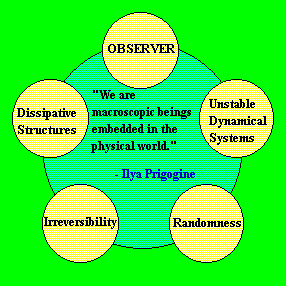
The Dynamic Process of Communication:


  • Observer
  • Unstable dynamical systems
  • Randomness, nonlinearity
  • Irreversibility
  • Dissipative Structures
  • Observer
  • Demonstrations of impossibility, whether in relativity, quantum mechanics, or thermodynamics, have shown that nature cannot be described "from the outside", as if by a spectator. Description is a dialogue, communication, and this communication is subject to constraints that demonstrate that we are macroscopic beings embedded in the physical world. We are evolved dissipative structures. The time symmetry is broken in the following way: the existence of irreversible processes on the microscopic level through kinetic equations violates the symmetry of the canonical equations. And dissipative structures may, in turn, break the symmetries of space-time.
    This is at the heart of Einsteins problem with quantum gravity. Inertia - change. Which takes us immidiately to the second law of thermodynamics. It works differently for living and ordinary matter? Why? And has it anything to do with the first law and the E=mc2? Energy is the interesting part, not only mass? Gauge fields and matter fields counterinteract. The fluctuation-dissipation theorem, or mass compressability*, says Radoslav Bozov.
     

    The conservation of mass is a fundamental concept of physics, as is the conservation of energy. Within some problem domain, the amount of mass remains constant; mass is neither created or destroyed. The mass of any object is simply the volume that the object occupies times the density of the object. For a fluid (liquid or gas) the density, volume, and shape of the object can all change within the domain with time and mass can move through the domain.
    *in the boson case, the connection between density fluctuations and compressibility was used to study superfluidity in a two-dimensional system.

    In addition to gauge fields, in nature there also are matter fields. The matter fields describe things such as electrons, neutrinos, quarks, and possibly Higgs particles. Gauge fields mediate “forces” between particles described by matter fields (and between additional particles described by the gauge fields themselves). Edward Witten 2009.
    The great insight was "Do not quantize", tells us Matti Pitkänen. No supergravity for him.

    What really IS the secret with Life?

    Prigogine has been one of my leading stars through my Journey. 1980 he wrote From Being to Becoming: Time and complexity in Physical Sciences. He has three main theses:
    (1) irreversible processes are as REAL as reversible ones.
    (2) irreversible processes play a fundamental CONSTRUCTIVE role in the physical world.
    (3) irreversibility is deeply rooted in dynamics.
    Most of the directional processes are irreversible or hypercyclic. Very few are totally reversible,and they are not at equilibrium. He adds, "This formulation leads to a unified picture that enables us to relate many aspects of our observations of physical systems to biological ones.
    "Biological order is both architectural and functional; furthermore, at the cellular and supercellular levels, it manifests itself by a series of structures and coupled functions of growing complexity and hierarchical character. This is contrary to the concept of evolution as described in the thermodynamics of isolated systems, which leads simply ... to 'disorder.' ... The unexpected new feature is that nonequilibrium may ... lead to a new type of structure, the DISSIPATIVE structures, which are essential in the understanding of coherence and organization in the nonequilibrium world in which we live."
    Again structure and function, inertia and change.

    Order out of Chaos, Prigogine 1984 in his intellectual odyssey from classical thermodynamics, through linear nonequilibrium thermodynamics, and finally to his holy grail of nonlinear nonequilibrium thermodynamics, and how the processes of entropy and energy scattering can lead a system open to its environment to evolve greater complexity.

    Open systems evolve complexity! Seen in structure of proteins? Molecular machines? But if we look only at complexity, then we forget the open system.
    The irreversibility (not invariant) in non-equilibrium thermodynamics, leading both to structure and function change. Take only the example with diffusion over a membrane.

    The End of Certainty, 1997.
    How is it, for instance, that basic principles of quantum mechanics-which lack any differentiation between forward and backward directions in time-can explain a world with an "arrow of time" headed unambiguously forward? And how do we escape classical physics' assertion that the world is deterministic? Prigogine explores deterministic chaos, nonequilibrium thermodynamics, and even cosmology and the origin of the universe... There is a way in which biology could be "reduced" to physics, but only if we learn to define "physics" very differently than we do today.
    Prigogine's explanation of Henri Poincaré's proof that contemporary physics' belief in reversible, closed-system, deterministic modeling actually precludes the arrow of time, obviates self-organization, and prohibits the existence of life itself. In short, Prigogine shows that Poincaré proved that biology CANNOT be reduced to contemporary physics, and he even proved why (the existence of Poincaré resonances). It's an exquisitely beautiful insight.

    Ironically, when the problems of biology has again and again been said to be the determinism and decoherence, seen from the light of Schrödinger and the double-slit experiment. Something is simply WRONG here, Lubos. Where is the build-up?

    Points toward a revolutionary realignment of fundamental physical principles, theoretical perspectives, and even scientific methodology - a coherent major shift in the foundational paradigms of physical science. Both Einstein and Schrödinger knew that contemporary physics is inadequate to explain more complex phenomena... like biological life.
    Newton's laws were once considered to be final.

    Prigogine 1997, Non-linear Science and the Laws of Nature: Simple examples such as the Bernouilli shift and the anharmonic lattice are studied. It is shown that instability as well as the thermodynamic limit lead to a new formulation of laws of nature in terms of probabilities (instead of trajectories or wave functions), following the realization that large classes of systems may exhibit abrupt transitions, a multiplicity of states, coherent structures or a seemingly erratic motion characterized by unpredictability often referred to as deterministic chaos. Distance from equilibrium, and therefore the arrow of time, plays an essential role in these processes, somewhat like temperature in equilibrium physics.
    Time is an operator.
    The 19th century has left us with a conflicting heritage. On one side, there are the 'laws of nature' such as Newton's law which relates acceleration to force. This law is time reversible and deterministic. If we know the initial condition of a dynamical system, we can predict its state at an arbitrary time, be it in the future or in the past. There is no distinction between past and future. These characteristics remain true in relativity and quantum mechanics, as the Einstein or Schrrdinger equations are also reversible and deterministic. On the other hand, the famous 'second law' of thermodynamics, associated with the increase of entropy, expresses the arrow of time.
    Stuart Kauffman has a probalistic approch in his "The origin of order."

    "Is the moon there when nobody looks
    ", asked Einstein. The observer - effect and consciousness. Are there consciousness outside living matter? The Anthropic effect simply cannot be true.

    What if we shift the focus from matter to waves, or probabilities, uncertainty? We start to explain our Universe in waves? Is the Universe Analog or Digital, asked FQXI in a contest last year, where I contributed. Maybe the answer is neither, but a TRINITY (particles-strings-waves) or (by replacing 1-dimensional strings with 3-dimensional light-like surfaces = self-containing = observer)? Or even a quartett? A tangent on a tangent? A quantized gauge theory with a mass gap? Maybe a superposition of many kinds (7 trees in one), so there are no definitive answer (E8?)? Also the fact that matter is only about 5% of total energy budget in Universe tells a lot. Dark matter is much more, about 20%. In which part is Life? WHAT is Life?

    "One can best feel in dealing with living things how primitive physics still is," said Einstein.

    If the equations of evolution are non-linear we observe, in general, bifurcations which lead to new spatio-temporal structures. The 'dissipative structures' achieved in this way are therefore the consequences of non-linearity. In this sense we may even consider life, with its essential non-equilibrium properties, as the manifestation of non-linearity. Close to equilibrium, entropy is maximum or free energy minimum. Free energy is reaction energy. To keep the reactivity negentropy must be maximized in living structures.

    "Laplace's demon", cannot be true. Laplace's demon was based on the premise of reversibility and classical mechanics. Invariance? Causal or scientific determinism, if someone knows the precise location and momentum of every atom in the universe, their past and future values for any given time ... killed by irreversibility (time?) and quantum world? Einsteins problem again. With a note, There has recently been proposed a limit on the computational power of the universe, i.e. the ability of Laplace's Demon to process an infinite amount of information. The limit is based on the maximum entropy of the universe, the speed of light, and the minimum amount of time taken to move information across the Planck length, and the figure was shown to be about 10120 bits. Accordingly, anything that requires more than this amount of data cannot be computed in the amount of time that has elapsed so far in the universe. The Lambda-cosmological constant-dark energy problem.

    The entire physical Universe cannot be fully understood by any single inference system that exists within it. on Cantor, Gödel and Turing’s theorems of incompleteness and uncountable.

    No hypothetical being with a “vast intellect”, such that, with full knowledge of the state of the Universe at one time, it can completely predict the future and recall the past with no uncertainty whatsoever. Do we call him the classic God? Are there a quantum God?

    Wolpert’s results (acc. to Binder) are particularly compelling because they are totally independent of both the details of the laws of physics and the computational characteristics of the machines. Wolpert, D. H. Physica D 237, 1257–1281 (2008). A prescription for deriving the laws of nature was proposed by Roy Frieden 2004. Science from Fisher Information: A Unification (Cambridge Univ. Press). Producing multiple solutions, as in M-theory-landscape?

    Non-linear time? Non-linear information? Through the attractor reconstruction method, in which a time series is converted into a geometrical trajectory in higher-dimensional spaces? Kantz, H. & Schreiber, T. Nonlinear Time Series Analysis (Cambridge Univ. Press, 2004). Sounds very TGD'ish, in light-like CD-diamonds and zero energy ontology.

    One can also know more than everything (superpositions of states). Quantum walk is another example (scattering?), as in photosynthesis or massively parallel computers (right brainhalf?), touching at a distance and Bells inequality, lattice with different spins where forward and backward propagating fields pick up polarization rotations in opposite senses, and may even reverse time... Quantum thermodynamics?
    Undoing a quantum measurement
    , quantum phase transitions... (non-local PDE's) How does a bosonic system store information about the Fermi energy, show how this fractal behavior would influence the thermodynamic response functions of liquid 3He, a fermionic fluid. The results could potentially be applied to understanding quantum critical behavior in heavy-fermion metals and high-temperature superconductors.

    The Yang-Mills equations are analogous to the vacuum Einstein equations Rμν = 0 (where R is the Ricci tensor). They are nonlinear hyperbolic wave equations. Most applications of partial differential equations involve domains with boundaries and periods, and use matrices (for scattering waves). Asymptotic charachter and resonance are other nonlinear equations. See Schrödinger eq. book.

    Is Future Given? 2003, when Prigogine died. No fate, the future has not been determined.

    He has consistently held that nature is probabilistic. Much of his motivation seems to have been in sorting out why Boltzman and Gibbs failed to satisfy the science community that their statistical physics explained the 2nd law, due to reversible classical equations and Poincare recurrences. However in order to make his probabilistic argument he may have created a loophole. He points to the Langevin equation as an irreversible equation with noise (friction) and he says Poincare should have connected nonintegrability with irreversibility and most dynamics are nonintegrable. However everyone agrees some (simple) systems are reversible (pendulums etc) so how can all of nature be stochastic? Maybe because the noise terms tend to but never go to zero?
    'The rate of change of entropy with time for a nonequilibrium stochastic process is always positive = the arrow of time.'

    In this case Poincare recurrence maybe a mere statistical fluctuation with no actuality. (Prigogine says it is false because he introduces new microscopic dynamics, the irreversible processes. At the website secondlaw.com the thermodynamic explanation of entropy is fundamental as it is a measure of energy diffusion, and not randomness or uncertainty, as the tool of statistical entropy would imply. In this way the 2 approaches are not contradictory; the statistical is merely a measurement tool for observers while the thermodynamic is real dynamics requiring no observers (ice melts, water crystalizes etc long before man was around). If anything this should be viewed as fundamental as it is a direct measurement of the physical movement of heat.

    One should not confuse information theory and measurement techniques with real underlying dynamics. When some authors say 'entropy is not a property of a system, it is a property of our description of the system. The quantum measuremental tools are badly developed.

    Prigogine has shown mathematically how irreversibility can apply at the microscopic level for nonintegral systems (in agreement with macroscopics) due to non-local persistent interactions.

    Non-linearity is also fractals, hierarchy, self-assembly. Infinity. No zero, no end.

    The importance of the individual's actions implies a reflection of each person on the responsibilities that each one assumes when taking or acting upon a decision. This responsibility is associated with the freedom of thought as well as a critical analysis of fashions, customs, preconceived ideas, and ideologies, externally imposed: exactly contrary to the ideas of those who wish us to be "perfect consumers" in a world dominated only by monetary wealth.


    Numerous molecules self-organize themselves in living organisms: actin and tubulin into filaments, lipids and proteins into membranes. Filaments and membranes are organized in cells that themselves are self-organized in tissues then in organs, and finally form the entire organism.

    Assemblies of molecules are formed and destroyed by weak interaction with binding energies (what is that energy in reality?) comparable to the thermal energy, rendering them very sensitive to the external conditions and easily adaptable to those conditions.

    Such self-organization patterns are not a feature of living systems solely; they occur in many physical and chemical systems composed for instance of molecules that are amphiphylic (both hydrophylic and hydrophobic), leading the way from simple material to the construction of biomimetic and microrobotic systems.

    Adaption relaxes stress. Energy is 'chrystallized', fixed. Movement diminished. Determinism and decoherence increased. Consequently coherence must be increased when the free energy is increased.

    And synchrony?

    "Maybe the details of the neurons are completely irrelevant. Maybe it is only a property of oscillators." says Babette K. Dellen. Neurons are composed of many elements and are typically nonlinear and, for example, have been modeled as interconnected, or "coupled", oscillators because of the way they interact with one another. Coupled oscillators can be imagined as being tethered to their nearest neighbor, thus influencing their movement. Neurons, on the other hand, may display repetitive electrical activity that can be influenced by the activity of neighboring neurons. Sebastian F. Brandt et coll. January 2006 Physical Review Letters.

    The origin of life was marked by the transition from chemical reactions to self-replicating molecular entities capable of evolving by natural selection. The structure and function of many biological molecules and supramolecular assemblies are today accessible in simulated “prebiotic’’ conditions; nevertheless we are still unable to establish a link between these structures and the complex metabolisms at work in living matter.

    There is no doubt that self-organization constitutes a key concept to understand collective phenomena, be it at the chemical, biological of behavioural level.
    Origins of Life: Self-Organization and/or Biological Evolution? Paris 2008 Maryvonne Gérin et Marie-Christine Maurel.
     
    Self and the collective? To be a we there must be an I first. Borders must be created to have an interference. Particles- strings- waves, says Radoslav Bozov. Inertia and change.
    To have 'a jump and a consciousness', says Matti Pitkänen..
    To Prigogine, irreversibility is a fundamental property of physics. Prigogine proposes that entropy production is part of an operator (operators map functions onto functions), and time is an operator. And that the time that we are all familiar with from classical mechanics is just an ensemble average of this operator with a state vector. I.e. "ordinary" time is an average over his new time operator. And that "age" is dependent of the distibution.
    So what does that mean about operators..? Let's say that we wish to know the time evolution of a system. In both quantum mechanics and classical mechanics, the Hamiltonian operator determines how the system will evolve in time. The evolution that we are all familiar with is a reversible and deterministic evolution (We can say that the reversible change of a wave function that represents the quantum system corresponds to a reversible motion along a trajectory that represents the classical system.) The wave function or trajectory represents the maximum knowledge of the system.
    Prigogine has incorporated reversible and irreversible parts into a new microscopic equation/description. The equation contains an operator analogous to the Hamiltonian, that is a new "time evolution operator" that now can drive the system to both equilibrium or nonequilibrium states. Entropy is produced by the even part of the new time evolution operator and he has defined an operator for that.
    An example that Prigogine gives looks at the conventional and his unconventional determination of energy levels in a quantum system. In the conventional quantum mechanics, both the energy levels and the time evolution of them are determined by the same quantity: the Hamiltonian operator. Prigogine's method allows him to use two different operators: the time operator for time evolution and another operator (a "superoperator" that can act on other operators) to determine the energy levels. So in this way, instead of having the "particle" and the "interaction" (conventional view), we have the physical process that contains electrons, photons, etc. that drive the total system. This process is "real" and cannot be "transformed" away by any change of representation.
    Or another way to look at it: the classical order says particles come first and the Second Law of Thermodynamics comes later, while Prigogine says that we must first introduce the Second Law before being able to define the entities.
    Another one of Prigigine's main themes is that nonlinear interactions frequently lead to order (which he calls "dissipative structures") through fluctuations. A dissipative structure is order visible on a macroscale which can exchange energy with the outside world. In particular, if the system is in a far-from-equilibrium-state this can happen.
    Conclusion: Scattering, quantum walk, parallell processing, hierarchy, fractality, entanglement are all related phenomena, that have big influence on the process of Life. Even thermodynamics itself may express non-locality through dispersion and scattering.

    ...the increase of entropy can be far more accurately described [than simply disorder] using terms such as ‘dispersal of energy,’ ‘spreading and sharing of energy,’ and ‘spatial and temporal spreading.’ In decoherence theory, a similar metaphor is used to describe the phenomena involved with quantum non-locality, superposition, and entanglement. Specifically the wavefunction of a quantum entity, such as a sub-atomic particle or photon is not seen to collapse but rather is transferred through interactions to a system and/or its environment. This suggests there may be a common basis for entropy and non-locality.
    Prigogine is primarily a chemist. As I understand it, his main discovery has been the discovery of "chemical clocks." These are chemical reactions that oscillate in a very regular and precise way. Prigogine predicted that they should exist from a theoretical chemistry standpoint several decades ago. In the late 1950's, one of his research group came back from a visit with a colleague in Russia, announcing that they had a chemical reaction that did just what Prigogine predicted. The reaction is now known as the Belousov-Zhabotininskii reaction and it is the oxidation of citric acid by potassium bromate catalyzed by the ceric-cerous ion couple.

    fredag 5 augusti 2011

    Artificial life conference, Paris.

    Next week it’s the European Artificial Life Conference (ECAL) 2011 in Paris.

    Artificial Life is an interdisciplinary undertaking that investigates the fundamental properties of living systems through the simulation and synthesis of biological entities and processes. It also attempts to design and build artificial systems that display properties of organisms, or societies of organisms, out of abiotic or virtual parts.

    ECAL, the European Conference on Artificial Life, is a biennial event that alternates with the US-based Alife conference series.

    Download the complete PDF program booklet (53-page, includes all the abstracts)


    I borrow this!

    So what is life?

    Posted by 5.8. on steennewmexico

    This question, of course, has to be addressed, if you want to create life from scratch. At our FLinT center in Denmark we study and implement life-like and minimal living processes in a variety of materials and systems. In particular we seek to assemble a minimal protocell, a minimal physicochemically based cell.

    First a little history:

    Von Neumann, the inventor of the modern computer, realized that if life is a physical process, it should be possible to implement life in other media than biochemistry. He was one of the first to propose the possibility of implementing genuine living processes in computers, robots and other media. This perspective, while still controversial, is rapidly gaining momentum in many science and engineering communities and it is the basis for our work. Ilya Prigogine reemphasized and clarified the importance of utilizing free energy fluxes to generate order in physicochemical systems through self-organization. The metabolic processes in our protocells utilize free energy to maintain local order. Our metabolism is a thermodynamic engine that locally drives our system away from equilibrium. Manfred Eigen pointed out that autocatalysis between functional physicochemical components could be a mechanism for the emergence of early life and that autocatalysis can enhance a systems ability to maintain information. All our protocellular components are autocatalytically coupled.

    Now, what is minimal physicochemical life then?

    There is not a generally agreed upon definition of life within the scientific community, as there is a grey zone of interesting processes between nonliving and living matter. Our work on assembling minimal physicochemical life is based on implementing systems that meets three criteria, which most modern biological life forms satisfy.

    In my opinion, and from a practical point of view, a minimal living physicochemical system needs to:

    1. use free energy to convert resources from the environment into building blocks so that it can grow and reproduce,
    2. have the growth and division processes at least partly controlled by inheritable information, and
    3. allow the inheritable information to change slightly from one generation to the next, thereby permitting variation of the growth and division processes and thus allow selection and hence evolution.

    How difficult can that be? Implementing these three simple criteria?

    Well, I’m telling you, it’s not easy. It’s very complicated, as it takes many components to fall into place at the same time, and these components are not only of scientific nature.

    For me personally, it took many years to convince any funding agency (peer review committee), that this kind of work is even possible. Secondly, we had to convince the committees that this work is worthy to spent tax payers money on: “In which sense will assembling minimal life benefit society?” Very important question, which I’ll get back to in some later blog. Only very few funding agencies give you money for basic, or curiosity driven, science.

    I’ll say, getting continued funding for our activities is still, and has been, the hardest part of creating life. It’s certainly more complex than doing the science.

    Secondly, due to the necessary complexities of the involved physicochemical systems, this kind of science is not a one-man activity. It takes a small village of skilled scientists from different disciplines, which gets us back to the previous point about money, as well as being able to host an exciting research environment.

    Finally, and of course most importantly, it takes human wondering and amazement about why things are the way they are, as well as the courage to dream about how things could be. And it takes very good people. Without good people nothing moves. And then it takes tenacity. A dedicated effort day after day (and sometimes nights), month after month, year after year.

    So don’t become a scientist unless you can’t help it. It consumes too much of you. But if you can’t help it, playing with your imagination and dreaming up new stuff, I believe is one of the most exhilarating things you can do as a human being. However, fundraising, writing grants, doing budgets, paying bills, dealing with whatever organization you are a part of, managing very smart people (herding cats), teaching, correcting exams, etc., is exhausting and can take some of the fun out of it. But that’s how it is. There are no free lunch.